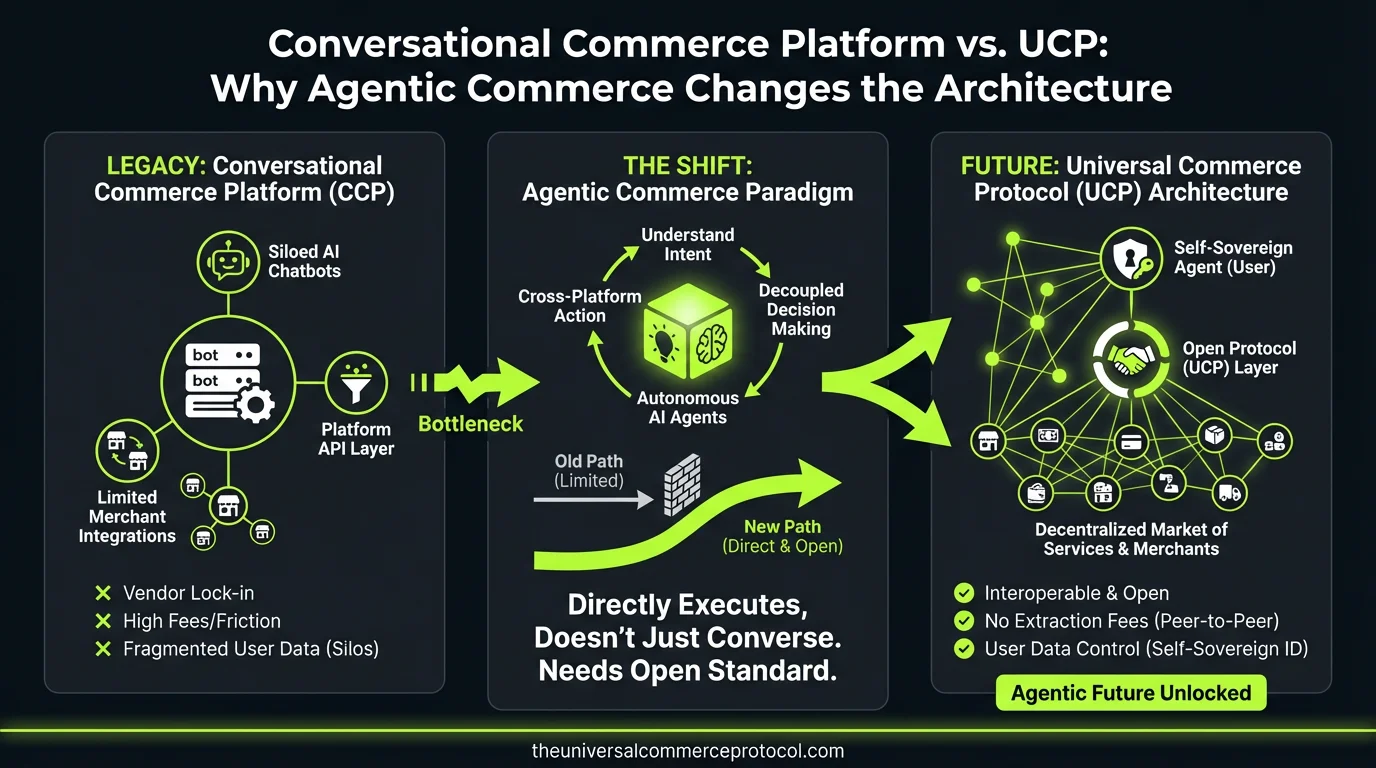
A conversational commerce platform is software that enables buyers to discover products, ask questions, get recommendations, and complete purchases through natural language conversation — rather than navigating menus, filling out forms, or clicking through a traditional checkout funnel.
Until 2025, that definition pointed to a category of point-solution vendors: Gorgias, LivePerson, Vonage, Zendesk’s messaging layer, WhatsApp Business integrations. The model was chatbot-on-top-of-checkout — a conversational interface bolted onto existing commerce infrastructure.
Related articles: UCP Shipping Carrier Selection & Rate Optimization • UCP Security Best Practices for AI-Driven Commerce
The Universal Commerce Protocol changes the architecture entirely. UCP doesn’t add a conversational layer to commerce. It makes any AI surface — Google Gemini, OpenAI’s ChatGPT, Amazon Alexa, or any future agent — natively capable of completing a full transaction. The AI surface is the commerce platform.
What Traditional Conversational Commerce Platforms Actually Do
To understand why UCP represents a category shift, it helps to be precise about what existing platforms do and don’t do.
Traditional conversational commerce platforms sit between a buyer and a merchant’s existing systems. They handle the conversation — parsing intent, answering questions, suggesting products, collecting preferences — and then hand off to the merchant’s checkout for payment. The conversation is the new front door; the backend is unchanged.
This model has real value. Gorgias integrates with Shopify to let support agents handle order lookups mid-conversation. LivePerson’s platform converts support conversations into sales opportunities. WhatsApp Business lets merchants in emerging markets run sales over messaging. These are meaningful capabilities.
But the architecture has a hard ceiling: every platform is a proprietary walled garden requiring a custom integration, and none of them can make a purchase happen autonomously. The buyer still has to click through to checkout. The agent still has to hand control back to the merchant’s UI.
How UCP Rewires the Architecture
UCP solves a different problem. Rather than adding conversational UI to existing checkout, it defines a shared protocol layer that any AI agent can use to initiate, manage, and complete a transaction on any compliant merchant — without the merchant building a custom integration for each AI platform.
The mechanism is the merchant capability profile, published at a standardized /.well-known/ucp endpoint. When an AI agent encounters a merchant, it queries this endpoint to discover exactly what the merchant supports: which checkout capabilities are available, which payment handlers are accepted, whether identity linking is configured, what fulfillment options exist. The agent then uses this information to complete the transaction entirely within its own interface.
No chatbot vendor sits in the middle. No proprietary platform mediates the conversation. The AI agent and the merchant speak the same open protocol.
UCP vs. Conversational Commerce Platforms: A Direct Comparison
| Dimension | Traditional Conversational Commerce Platform | UCP-Native Agentic Commerce |
|---|---|---|
| Architecture | Middleware layer added to existing checkout | Protocol layer — AI agent completes purchase natively |
| Integration model | Proprietary per-platform (Gorgias needs Shopify plugin, etc.) | Open protocol — one implementation works across all UCP-compatible agents |
| Who controls the interface | Platform vendor + merchant | AI agent (Gemini, ChatGPT, Alexa, etc.) |
| Transaction completion | Buyer must still complete checkout separately | Agent completes transaction autonomously within conversation |
| Buyer consent model | Implicit — buyer is present at each transaction | Explicit — OAuth mandate + AP2 cryptographic proof of intent |
| Payment execution | Routes to merchant’s existing checkout | Google Pay or other registered payment handler, in-agent |
| Cross-platform reach | One platform = one set of surfaces | Any UCP-compatible AI agent, globally |
| Vendor dependency | High — platform is the chokepoint | None — open standard, no intermediary required |
The Three Commerce Surfaces UCP Converts Into Native Platforms
Google AI Mode and Gemini
When Google launched AI Mode in Search in early 2026, it introduced a native shopping capability powered by UCP. Buyers searching for products inside AI Mode can initiate a checkout session, select shipping preferences, and complete payment via Google Pay — all without leaving the search interface. For merchants connected to UCP through Google Merchant Center, this makes every Google AI surface a de facto conversational commerce platform. No third-party chatbot required.
OpenAI’s ChatGPT Instant Checkout
OpenAI’s commerce integrations, launched in partnership with Shopify merchants, allow users to complete purchases inside ChatGPT conversations. The underlying infrastructure uses merchant REST APIs and payment handler negotiation — the same primitive model UCP formalizes as an open protocol. As UCP adoption grows, ChatGPT’s commerce capabilities are likely to converge on the shared standard rather than maintain proprietary integrations with each merchant.
Voice and Ambient Commerce (Alexa, Smart Home)
Amazon’s Buy with Prime program and Alexa’s shopping integrations represent the voice surface of conversational commerce. UCP’s architecture extends naturally to voice — the capability negotiation, checkout session model, and payment handler selection all function without a visual interface. A buyer saying “order the dog food I usually get” to an Alexa-compatible agent triggers the same UCP flow as a typed query in Gemini.
What Merchants Actually Need to Build
If UCP makes any AI surface a native conversational commerce platform, what does that mean for merchants evaluating their options? The answer is more direct than most vendor pitches suggest.
You don’t need a conversational commerce platform vendor. You need UCP readiness. That means:
Publish the /.well-known/ucp endpoint. This JSON capability profile is how every AI agent discovers your store. Without it, you’re invisible to UCP-native commerce surfaces. It’s a one-time configuration, not an ongoing platform subscription.
Configure Google Pay as a payment handler. Google Pay is the primary payment execution method for Gemini-mediated transactions. Merchants without it are excluded from the most significant current UCP surface.
Implement OAuth 2.0 identity linking. Publish your authorization server at /.well-known/oauth-authorization-server. This enables account-linked checkout — saved addresses, loyalty points, personalized pricing — inside agent interfaces.
Optimize Google Merchant Center feeds with native_commerce attributes. The native_commerce attribute signals UCP readiness to Google’s systems. Clean, complete product data with accurate inventory and fulfillment information determines whether your products appear in agentic shopping results.
Submit the UCP merchant interest form. Access to Google’s UCP-integrated surfaces is currently gated by waitlist. The bottleneck is the form, not the technical build.
Should You Still Use a Conversational Commerce Platform?
The honest answer: depends on your use case.
Traditional conversational commerce platforms still have a strong role in customer support, post-purchase service, and complex pre-sale consultation — scenarios where a human agent or specialized chatbot adds value that a general-purpose AI shopping assistant doesn’t yet replicate. If you’re running a high-consideration category (luxury goods, custom orders, technical products requiring expert guidance), a platform like Gorgias or Zendesk Messaging continues to deliver real value.
For transactional commerce — discovery, recommendation, checkout, and payment — UCP is the better architecture. It reaches more surfaces, requires no platform vendor, creates no intermediary fee structure, and is built on an open standard that will only get more widely supported as Google, Shopify, and OpenAI’s ecosystems mature.
The most forward-looking merchants are doing both: maintaining a conversational support layer for complex interactions and building UCP readiness for autonomous transactional commerce. Those aren’t competing investments — they address different moments in the buyer journey.
Frequently Asked Questions
What is a conversational commerce platform?
A conversational commerce platform is software that enables buyers to discover, evaluate, and purchase products through natural language conversation rather than traditional browse-and-checkout interfaces. Traditional platforms (Gorgias, LivePerson, Zendesk) add conversational UI on top of existing checkout. UCP-native agentic commerce makes the AI agent itself a complete commerce platform — no separate platform layer required.
How does UCP replace traditional conversational commerce platforms?
UCP provides a shared open protocol that any AI agent can use to complete transactions on any compliant merchant — without a proprietary platform sitting in the middle. Rather than adding a chatbot layer to checkout, UCP makes checkout native to the AI surface. This eliminates the per-platform integration burden and removes vendor dependency from the transactional flow.
What is the difference between conversational commerce and agentic commerce?
Conversational commerce involves a human buyer interacting with a chat interface to make purchasing decisions — the buyer remains active throughout. Agentic commerce allows an AI agent to complete purchases autonomously on behalf of a buyer, based on pre-established preferences and OAuth authorization. UCP enables agentic commerce; traditional conversational commerce platforms enable assisted conversational commerce.
Which AI platforms support UCP conversational commerce natively?
Google Gemini and Google AI Mode in Search are the primary UCP-native surfaces currently in production. OpenAI’s ChatGPT has commerce integrations with Shopify merchants that use similar architectural primitives. Amazon’s Alexa and Buy with Prime are building toward agentic commerce compatibility. UCP’s open protocol design means any AI agent can implement support without permission from a central authority.
Do I need to pay for a conversational commerce platform to use UCP?
No. UCP is an open protocol — there is no platform vendor and no license fee. Merchants implement UCP directly through their existing commerce infrastructure (Shopify, custom stack, etc.) and Google Merchant Center. The investment is in technical readiness: publishing the /.well-known/ucp endpoint, configuring Google Pay, and optimizing product feeds.
What does agentic commerce platform mean?
An agentic commerce platform is an AI surface capable of completing purchases autonomously — acting as both the discovery and transaction layer without requiring the buyer to manually complete checkout. Under UCP, any AI agent that implements the protocol becomes an agentic commerce platform. This is distinct from traditional conversational commerce platforms, which assist human buyers but still require manual checkout completion.
Leave a Reply