I sent my developer Pinto a technical brief this morning. A proper one — tables, API endpoints, research citations, implementation options, the works. Six pages. Formatted perfectly.
He’s going to feed it directly to his AI for context. He won’t read it.
And I won’t read his response either. I’ll feed it to mine.
This isn’t a failure of communication. It’s the beginning of something much bigger — and it connects directly to what we’re building with the Universal Commerce Protocol.
We’re Still Formatting Knowledge for Eyes That Aren’t Looking
Think about how much of your day is spent producing or consuming information packaged for human eyeballs. Emails with greetings and sign-offs. Briefs with executive summaries. Slack messages with emoji reactions. Reports with charts designed to be glanced at in a meeting.
Now think about what actually happens to most of that information. It gets scanned — not read. Summarized by AI. Fed into another system. Forwarded to someone who also won’t read it. The format is a relic. The content might matter, but the packaging is theater.
Pinto and I realized we’ve been performing this theater for each other. We write documents that look like documents because that’s what communication is supposed to look like. But the actual consumer of the information — the AI system that processes it into actionable context — doesn’t care about your header formatting or your bullet point alignment.
It cares about one thing: what’s new?
The Knowledge Delta
Here’s the concept that’s been crystallizing for me: the real unit of exchange between people (and increasingly between systems) isn’t a “message.” It’s a knowledge delta — the difference between what the recipient already knows and what the sender is communicating.
Everything else is noise. Pleasantries, formatting, context the recipient already has, information that hasn’t changed since the last update — it’s all packaging around the delta.
Once you see communication this way, the entire architecture of how information moves between people starts to look obsolete. Email isn’t broken because of volume. It’s broken because it treats every inbound item as equally worthy of your attention, with no awareness of what you already know.
The System That Should Exist
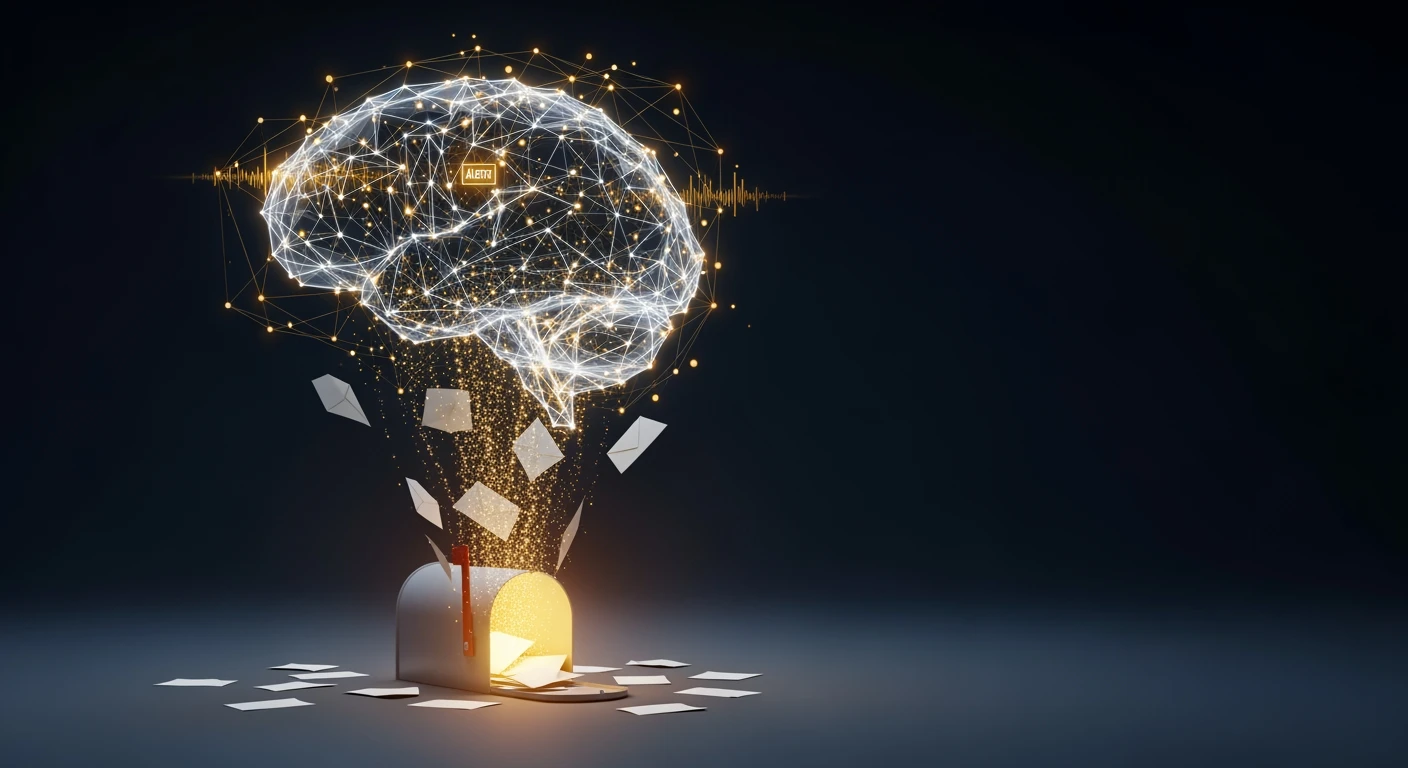
Imagine every piece of inbound information — emails, briefs, cold outreach, reports, Slack messages, newsletters — hitting a triage layer before it reaches you. That layer compares each item against your “second brain” (your accumulated knowledge base) and does one of three things:
Nothing new → drops it silently. You never see it. A vendor you already evaluated sends another pitch with no new information. Gone. A weekly report where nothing changed from last week. Gone. No notification, no inbox clutter. It doesn’t exist to you.
New knowledge, no urgency → extracts the delta and deposits it. Like a contribution to a retirement account. A competitor mentioned a new pricing model in a newsletter. You don’t need to act on it right now, but six months from now when you’re renegotiating a contract, that data point will be sitting in your knowledge bank, compounding quietly alongside a thousand other small deposits. The system extracts the one new fact, tags it, and files it. You never “read” the newsletter.
New knowledge + active trigger → surfaces an alert. Someone you were waiting to hear from finally responded. A product you flagged went on sale. A regulatory change affects a deal you’re working on. The system recognizes that this delta matches something you’re actively tracking and interrupts you — but only for this. Everything else stays in the background.
The default is silent accumulation. Interruption is the exception.
Two Cold Emails Walk Into a Triage Layer
Here’s the concrete version. Two cold emails arrive in your inbox this afternoon.
Email one is from a SaaS vendor you evaluated three months ago. You decided against them. Their email describes the same product with minor feature updates. Your knowledge bank already contains your evaluation, your decision, and the reasoning. The triage layer compares the email against what you know, finds nothing that changes your assessment, and drops it. You never see it.
Email two is from a different vendor. Buried in the third paragraph is a mention that they now support an API integration you specifically identified as a blocker in a Notion note eight weeks ago. The triage layer extracts that one fact, matches it against your stored intent (“alert me if Vendor X adds API support”), and fires a notification. The rest of the email — the marketing copy, the customer testimonials, the “limited time offer” — gets deposited as context in your knowledge bank but doesn’t interrupt you.
You never “read” either email. But you got smarter from one and got notified about the thing that mattered from the other.
This Is What UCP Is Doing for Commerce
If this sounds familiar, it should. The Universal Commerce Protocol is applying exactly this principle to commercial transactions. Traditional e-commerce is built around human-formatted storefronts — product pages with hero images, marketing copy, reviews, and “Add to Cart” buttons. All of that is packaging designed for human eyeballs.
But when an AI agent is the buyer, none of that packaging matters. The agent needs the delta: What products exist? What are the current prices? What’s in stock? What are the terms? UCP strips away the theater and exposes the structured data that agents actually need to transact.
The parallel is exact. Email is to knowledge what storefronts are to commerce — a human-readable interface that’s increasingly consumed by machines. UCP solves this for buying and selling. The knowledge delta concept solves it for everything else.
The Knowledge Retirement Account
The metaphor I keep coming back to is the retirement account. Most people don’t think about their 401(k) contributions on a daily basis. Money goes in automatically, gets invested, compounds over years, and the value is realized later — often much later. The power isn’t in any single contribution. It’s in the accumulation.
Knowledge works the same way. Most of what you learn today won’t be useful today. But it will be useful eventually — in a meeting next month, a negotiation next quarter, a strategic decision next year. The problem is that our current information systems (email, chat, feeds) are designed for immediate consumption, not long-term accumulation. They’re checking accounts when what we need is a retirement fund.
A knowledge delta system flips this. Every piece of new information gets deposited automatically. You don’t have to decide in the moment whether it’s important. The system tags it, relates it to what you already know, and makes it retrievable when the context demands it. The compound interest accrues in the background.
We’re Already Doing This (Badly)
Pinto and I are already living in a version of this system. We use Notion as a second brain. We use Claude as a triage and synthesis layer. When I need to know the state of a project, I don’t go read Pinto’s last three messages — I ask my AI to synthesize the current state from everything it knows.
But it’s manual. It’s fragile. And it requires us to still produce and send documents formatted for humans even though the human is no longer the reader.
The next step — the one that feels inevitable — is removing that pretense entirely. Outputs that are structured for machine consumption from the start. Triage that happens automatically at the intake layer. Accumulation that’s continuous and silent. Alerts that are rare and high-signal.
We’re building pieces of this right now. Pinto is working on the intelligent context layer for our UCP chatbot — teaching it to understand not just individual articles but the relationships between topics, the taxonomy that connects them, the semantic structure of the entire knowledge base. That’s the infrastructure that makes delta detection possible.
What This Means for Everyone Else
If you’re a business owner drowning in email, the answer isn’t inbox zero. It’s an intake layer that knows what you already know and only shows you what’s genuinely new.
If you’re a developer building communication tools, the opportunity isn’t a better email client. It’s a system that treats incoming information as knowledge deposits rather than items requiring attention.
If you’re thinking about AI strategy, the most valuable investment isn’t better chatbots. It’s building the knowledge infrastructure — the second brain, the taxonomy, the intent triggers — that lets AI systems triage and accumulate on your behalf.
The future of communication isn’t better messages. It’s better knowledge intake. Silent accumulation as the default. Interruption as the exception. And a retirement account for everything you learn, compounding quietly until you need it.
That brief I sent Pinto this morning? It was the last one I’ll format for human eyes. From here on out, we’re formatting for the delta.
Leave a Reply