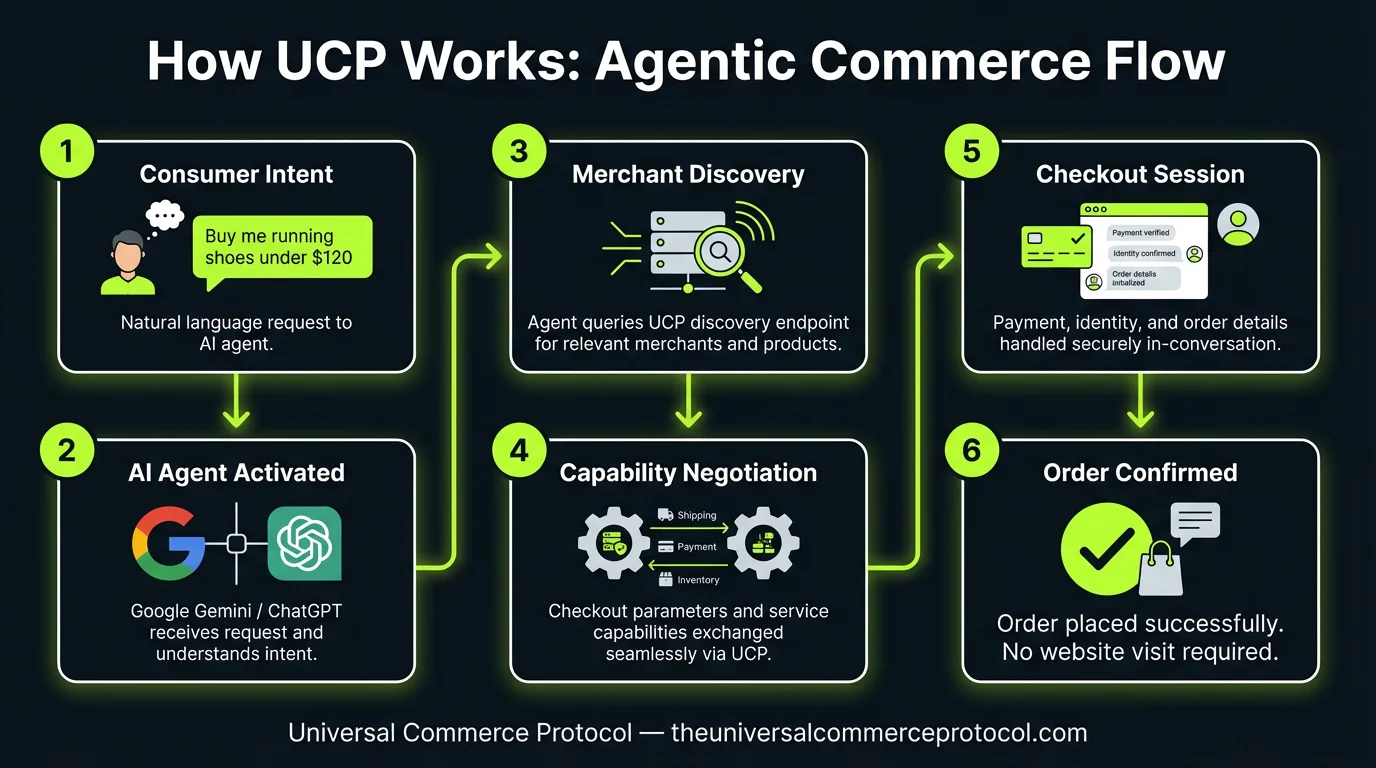
Agentic commerce is the term defining a fundamental shift in how transactions happen on the internet. Instead of a person browsing a website, clicking through product pages, adding items to a cart, and manually entering payment details, an AI agent performs these actions on their behalf — discovering products, comparing options, negotiating checkout terms, and completing purchases within the flow of a natural conversation.
This is not a future prediction. As of early 2026, agentic commerce is live. AI agents powered by Google’s Gemini, OpenAI’s ChatGPT, and other large language models are executing real purchases for real shoppers. The infrastructure enabling this shift is the Universal Commerce Protocol (UCP), an open standard that gives AI agents a common language to interact with merchant systems.
From E-Commerce to Agentic Commerce: What Changed
Traditional e-commerce was built on the assumption that humans interact with graphical user interfaces. Every element of the online shopping experience — search bars, category filters, product grids, shopping carts, checkout forms — exists because a person needs to navigate a screen to express purchasing intent. The entire multi-billion dollar industry of conversion rate optimization exists because these interfaces create friction at every step.
Agentic commerce removes the interface. When a shopper tells an AI assistant “find me running shoes under $150 with good arch support that I can get delivered by Friday,” the agent handles the entire workflow: querying multiple merchant catalogs, filtering by price and specifications, checking real-time inventory and delivery estimates, and presenting the best options. If the shopper says “buy the second one,” the agent completes the transaction using saved payment credentials — no cart, no checkout form, no account creation.
The economic implications are significant. Bain & Company predicts that by 2030, agentic commerce could represent 15-25% of total online retail sales in the U.S. domestic market, a range of $300 billion to $500 billion. Merkle predicts that nearly a quarter of all commerce will be agentic by that same year.
How AI Agents Actually Execute a Purchase
Understanding agentic commerce requires understanding the mechanics of how an AI agent interacts with a merchant’s systems. The process follows a structured sequence enabled by protocols like UCP:
Discovery: The agent queries a merchant’s /.well-known/ucp endpoint to understand what the store offers and how to interact with it. This is the machine-readable equivalent of a shopper visiting a store’s homepage.
Capability Negotiation: The agent and the merchant’s system exchange information about what each side supports. The merchant declares its checkout paths, payment handlers, and fulfillment options. The agent declares what credentials and payment methods it can provide on behalf of the shopper.
Product Query: The agent searches the merchant’s catalog using real-time API calls, not cached product feeds. This means the agent sees current pricing, live inventory, and up-to-date product details.
Checkout Session: When the shopper signals purchase intent, the agent initiates a checkout session — a structured transaction that reserves inventory, calculates totals (including tax and shipping), processes payment through the selected handler, and confirms the order.
Post-Purchase: The agent can track order status, initiate returns, and manage the ongoing customer relationship through the same protocol.
Why the Shopping Cart Is Becoming Obsolete
The shopping cart was invented because web browsers needed a mechanism to accumulate items before a single payment transaction. It is a technical artifact of the HTTP request-response model, not a natural expression of shopping intent. In a conversational interface, the concept of a cart is unnecessary — the agent maintains the full context of what the shopper wants and can execute multi-item purchases in a single transaction.
Cart abandonment — the single largest revenue leak in e-commerce, with an average rate of approximately 70% — is structurally eliminated in agentic commerce. There is no cart to abandon. The shopper expresses intent, the agent fulfills it, and the transaction completes within the conversation. No form fields to fill out, no account to create, no password to remember.
The Role of UCP in Enabling Agentic Commerce
Agentic commerce at scale requires standardization. Without a shared protocol, every AI platform would need custom integrations with every merchant — an exponentially growing problem that Google has described as the “N x N integration bottleneck.” If there are 100 AI surfaces and 10,000 merchants, that is potentially one million unique integrations.
UCP collapses this into a single integration point. A merchant that implements UCP once is accessible to every AI agent that supports the protocol. An AI platform that supports UCP can interact with every UCP-compatible merchant. This is the same network effect that made HTTP the universal protocol for web pages — except UCP is the universal protocol for commerce transactions.
UCP is also designed to be interoperable with other emerging protocols. It works alongside the Agent2Agent (A2A) protocol for inter-agent communication, the Agent Payments Protocol (AP2) for secure payment authorization, and the Model Context Protocol (MCP) for connecting AI models to external tools and data sources.
What Agentic Commerce Means for Different Stakeholders
For Consumers
Shopping becomes faster, more personalized, and less frustrating. AI agents can compare prices across dozens of merchants in seconds, remember your preferences and purchase history, and handle the mechanical work of completing a transaction. The value proposition is time saved and better purchase decisions through comprehensive comparison.
For Merchants
Agentic commerce opens new sales channels without the cost of building and maintaining separate storefronts for each AI platform. Merchants who implement UCP gain access to shoppers on Google AI Mode, Gemini, and any future AI surface that adopts the protocol. Critically, merchants remain the Merchant of Record — they keep their customer data and relationships.
For Payment Providers
The payment layer in agentic commerce is modular and open. UCP’s payment handler architecture means that any payment provider — from Visa and Mastercard to digital wallets and buy-now-pay-later services — can participate without needing to be baked into the core protocol.
The Competitive Protocol Landscape
UCP is not the only protocol addressing agentic commerce. OpenAI and Stripe have developed the Agentic Commerce Protocol (ACP) for ChatGPT’s Instant Checkout feature. The key difference is that ACP focuses on the checkout layer within a single platform, while UCP aims to standardize the entire commerce journey across all platforms.
This parallel development is actually healthy for the ecosystem. Competition between protocols drives faster innovation, and the modular nature of both standards means interoperability is technically achievable. The long-term outcome may be convergence around shared primitives with platform-specific extensions.
Frequently Asked Questions
What is agentic commerce in simple terms?
Agentic commerce is when AI assistants like Google Gemini or ChatGPT handle shopping tasks for you — finding products, comparing prices, and completing purchases on your behalf through conversation rather than traditional website browsing.
Is agentic commerce the same as voice shopping?
Voice shopping is one form of agentic commerce, but the concept is broader. Agentic commerce includes any interaction where an AI agent executes commerce tasks on behalf of a consumer, whether through voice, text, video, or multimodal interfaces.
Can AI agents already make purchases for me?
Yes. As of early 2026, UCP-powered checkout is live in Google’s AI Mode in Search and the Gemini app for select U.S. retailers including Etsy and Wayfair, with Shopify, Target, and Walmart integrations coming soon.
Is my payment information safe with agentic commerce?
UCP uses tokenized payment processing through established providers like Google Pay. Your raw payment credentials are never shared with AI agents. The Agent Payments Protocol (AP2) provides cryptographic proof of user consent for every transaction.
Will agentic commerce replace traditional online stores?
Not entirely. Agentic commerce is a new channel, not a replacement. Traditional web storefronts, mobile apps, and in-store shopping will continue to coexist. However, an increasing share of transactions — particularly high-intent, convenience-driven purchases — is expected to shift to agentic channels.
How big will agentic commerce get?
Industry analysts project significant growth. Bain & Company estimates agentic commerce could reach 15-25% of total U.S. online retail sales by 2030. Merkle predicts nearly a quarter of all commerce will be agentic by the same year.
🎙️ The UCP Brief — Audio Summary
Read transcript
Welcome to The UCP Brief.
Today we’re diving into agentic commerce, which is essentially AI agents taking over your online shopping. Forget endless scrolling and clunky shopping carts. Instead, imagine telling your AI assistant exactly what you want, and it handles everything from finding the best deals to making the purchase, all within a seamless conversation. This isn’t some far-off fantasy; it’s happening right now, powered by AI from companies like Google and OpenAI.
The key enabler is the Universal Commerce Protocol, or UCP. Think of it as a universal translator for AI agents and online stores. It allows these agents to understand what a store offers and how to interact with its systems, all without needing human intervention. This means no more friction-filled online experiences. Just pure, intent-driven shopping.
The implications here are massive. Experts predict that agentic commerce could account for a significant chunk of online retail within the next few years – we’re talking hundreds of billions of dollars. This shift will reshape how businesses sell online and how we, as consumers, discover and buy products. It’s a brave new world of autonomous transactions, and the UCP is the foundation.
I’m Will Tygart. Stay curious.
Leave a Reply