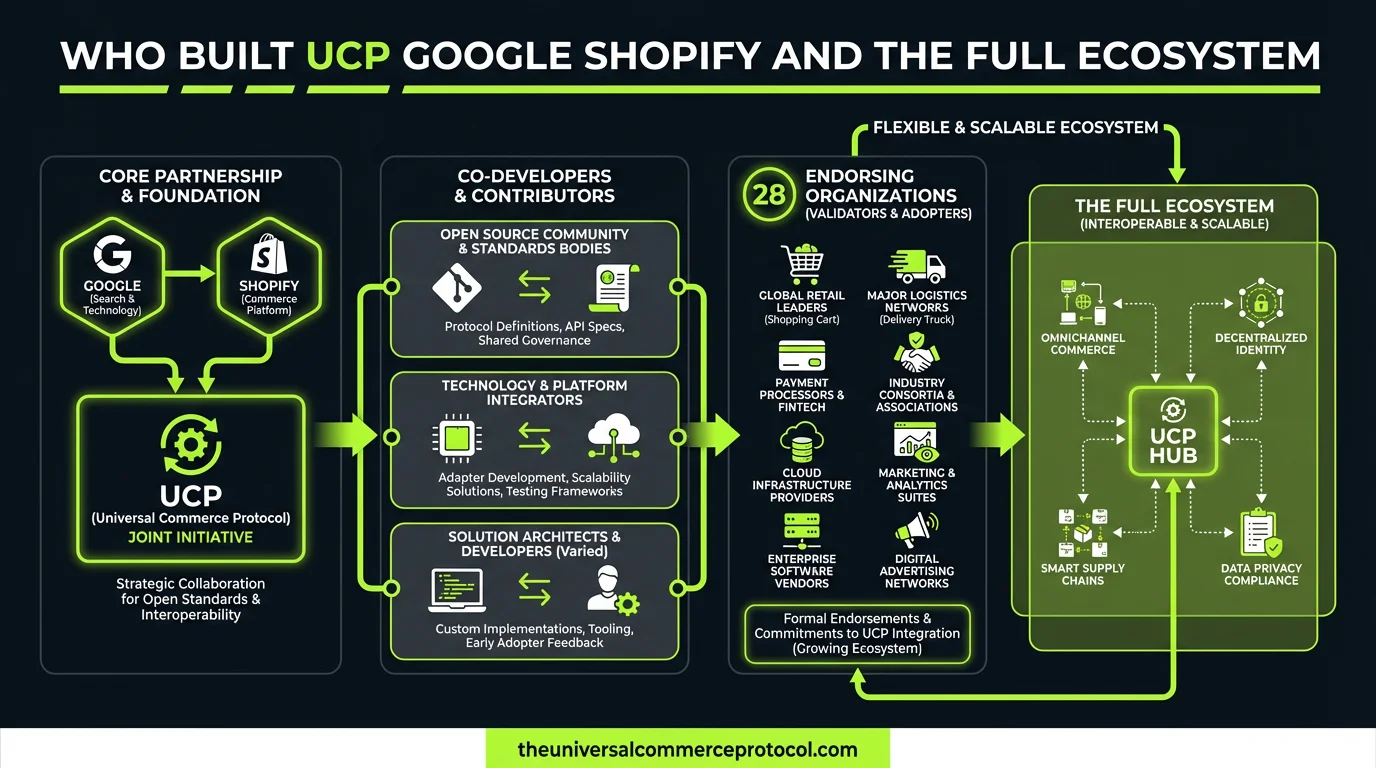
The Universal Commerce Protocol was co-developed by Google and Shopify in collaboration with four additional retail co-developers — Etsy, Wayfair, Target, and Walmart — and has been endorsed by 28 additional organizations spanning global retail, payments networks, buy-now-pay-later providers, and marketplace platforms.
The breadth of this consortium is not incidental. It reflects a deliberate co-design process in which organizations with competing interests and vastly different commerce requirements contributed their real-world complexity to the protocol’s architecture. The result is a standard built for the full diversity of commerce, not a simplified model optimized for a single use case.
This article covers every confirmed participant at launch, their role, and what their involvement means for the protocol. All partner information is sourced directly from the official UCP website and the Google launch announcement of January 11, 2026.
The Co-Developers: Organizations That Built UCP
Six organizations are credited as UCP co-developers. These are the parties that participated in designing the protocol itself — not merely endorsing it after the fact.
Google initiated UCP and built the first reference implementation of the protocol to power checkout inside Google AI Mode in Search and the Gemini app. Ashish Gupta, VP/GM of Merchant Shopping at Google, described the motivation: “The shift to agentic commerce will require a shared language across the ecosystem — and the Universal Commerce Protocol provides that framework.” Google also published the official developer documentation at developers.google.com/merchant/ucp and the UCP specification site at ucp.dev.
Shopify
Shopify is the primary technical co-developer of UCP alongside Google. Ilya Grigorik, Distinguished Engineer at Shopify, authored the detailed architectural design documented in the Shopify Engineering post. Shopify contributed decades of experience processing billions of transactions for millions of merchants to the protocol’s design — particularly around checkout complexity, payment handler negotiation, and the embedded checkout model. The Embedded Checkout Protocol (ECP) within UCP is derived from Shopify’s own Checkout Kit. Vanessa Lee, VP at Shopify, stated: “Shopify has a history of building checkouts for millions of unique retail businesses. We have taken everything we’ve seen over the decades to make UCP a robust commerce standard that can scale.” Source: Shopify Newsroom, January 11, 2026.
Etsy
Etsy participated as a co-developer of UCP, contributing the perspective of a marketplace platform serving independent sellers with highly varied product types, shipping arrangements, and seller policies. Etsy’s involvement shaped how UCP accommodates marketplace-specific commerce complexity.
Wayfair
Wayfair co-developed UCP with particular relevance to large-format and furniture retail — commerce categories that involve complex fulfillment requirements including delivery windows, assembly services, and white-glove logistics. Wayfair’s participation directly informs how UCP handles scenarios where buyer input is required for fulfillment that cannot be resolved autonomously by an agent.
Target
Target participated as a co-developer, contributing the operational complexity of a large omnichannel retailer managing both in-store and online inventory, click-and-collect fulfillment, and RedCard loyalty integration. Target’s involvement helped shape how UCP handles multi-channel retail complexity.
Walmart
Walmart co-developed UCP, bringing the scale and diversity of the world’s largest retailer — including grocery, general merchandise, marketplace sellers, and Walmart+ membership — to the protocol’s design. Walmart’s participation shaped how UCP handles membership programs and high-volume, diverse-category retail at scale.
Source for all co-developer information: ucp.dev and Google Blog, January 11, 2026.
The Endorsers: Organizations Supporting UCP Adoption
The following organizations are confirmed endorsers of UCP as listed on the official UCP website at launch. Endorsers represent a commitment to the protocol’s adoption and interoperability without necessarily having participated in designing the specification.
Payment Networks and Processors
- Visa — global payment network
- Mastercard — global payment network
- American Express (Amex) — global payment network and card issuer
- Adyen — global payment platform for enterprise merchants
- Stripe — payment infrastructure for internet businesses
- Fiserv — financial services technology company
- Worldpay — global payment processing
- Checkout.com — global payment solutions provider
- Ant International — international digital payments and financial services (Alibaba Group)
- Block — financial services and payment technology company (formerly Square)
- PayPal — global digital payments platform
- Splitit — installment payment solutions
- Affirm — buy-now-pay-later payment provider
- Klarna — buy-now-pay-later and shopping platform
Retailers
- Best Buy — consumer electronics retailer
- The Home Depot — home improvement retailer
- Macy’s Inc. — department store retailer
- Flipkart — Indian e-commerce marketplace
- Zalando — European fashion e-commerce platform
- Carrefour — French multinational retail corporation
- Gap — American clothing and accessories retailer
- Kroger — American supermarket chain
- Lowe’s — home improvement retailer
- Sephora — beauty products retailer
- Ulta Beauty — beauty retailer
- Chewy — online pet food and products retailer
- Shopee — Southeast Asian e-commerce platform
Commerce Technology
- Salesforce — CRM and commerce technology platform (Salesforce Commerce Cloud)
Source for complete endorser list: ucp.dev.
Why the Consortium Composition Matters
The participation of competing organizations — Visa and Mastercard, Stripe and Adyen, Walmart and Target — in a single open standard is significant for three reasons:
First, it signals genuine industry alignment. Open standards that serve only one stakeholder’s interests rarely achieve broad adoption. The co-development process required these organizations to negotiate protocol design choices that work across their competing requirements — producing a result more durable than any single-vendor solution.
Second, it creates immediate network effects. Merchants integrating with UCP gain access to commerce surfaces connected to every participating platform. Payment providers integrating their payment handlers gain exposure to every merchant using UCP. The protocol’s value grows with each participant.
Third, it establishes the open-source governance model. UCP is published under the Apache License, Version 2.0, with its full specification available at github.com/Universal-Commerce-Protocol/ucp. Community contributions, GitHub discussions, and pull requests are the mechanisms through which the protocol evolves — not decisions made by any single company. Source: ucp.dev.
How to Get Involved
- UCP GitHub Repository — read the spec and contribute
- UCP Contributing Guide
- ucp.dev — official documentation
- Merchant Integration Waitlist (for Google AI surfaces)
Primary Sources for This Article
- Universal Commerce Protocol official website (ucp.dev) — complete partner list
- Google Blog: New tech and tools for retailers to succeed in an agentic shopping era (January 11, 2026)
- Shopify Newsroom: The agentic commerce platform (January 11, 2026)
- Shopify Engineering: Building the Universal Commerce Protocol (January 11, 2026)
🎙️ The UCP Brief — Audio Summary
Read transcript
Welcome to The UCP Brief.
Today we’re diving into the Universal Commerce Protocol, and specifically, who was actually in the room when this thing was built. It’s not just some theoretical white paper. Google and Shopify spearheaded the development, but it’s the extended roster of retail giants that really tells the story. This wasn’t just a tech company initiative. It was a collaborative effort to solve real-world commerce problems.
Beyond Google and Shopify, you’ve got Etsy, Wayfair, Target, and Walmart as co-developers. That’s a huge range of business models feeding into the protocol’s DNA. Etsy brought the perspective of independent sellers and complex marketplaces, while Wayfair focused on the unique challenges of large-format goods. This diversity is key. UCP aims to be a universal solution, not just one tailored to a specific niche.
And it doesn’t stop there. Twenty-eight other organizations, from payment networks to buy-now-pay-later providers, have endorsed UCP. This broad support signals a real commitment to adopting a standardized approach to autonomous transactions. The takeaway here is that UCP isn’t just a product, it’s a coalition. This collaborative spirit is what gives it the potential to truly reshape the future of commerce.
I’m Will Tygart. Stay curious.
Leave a Reply