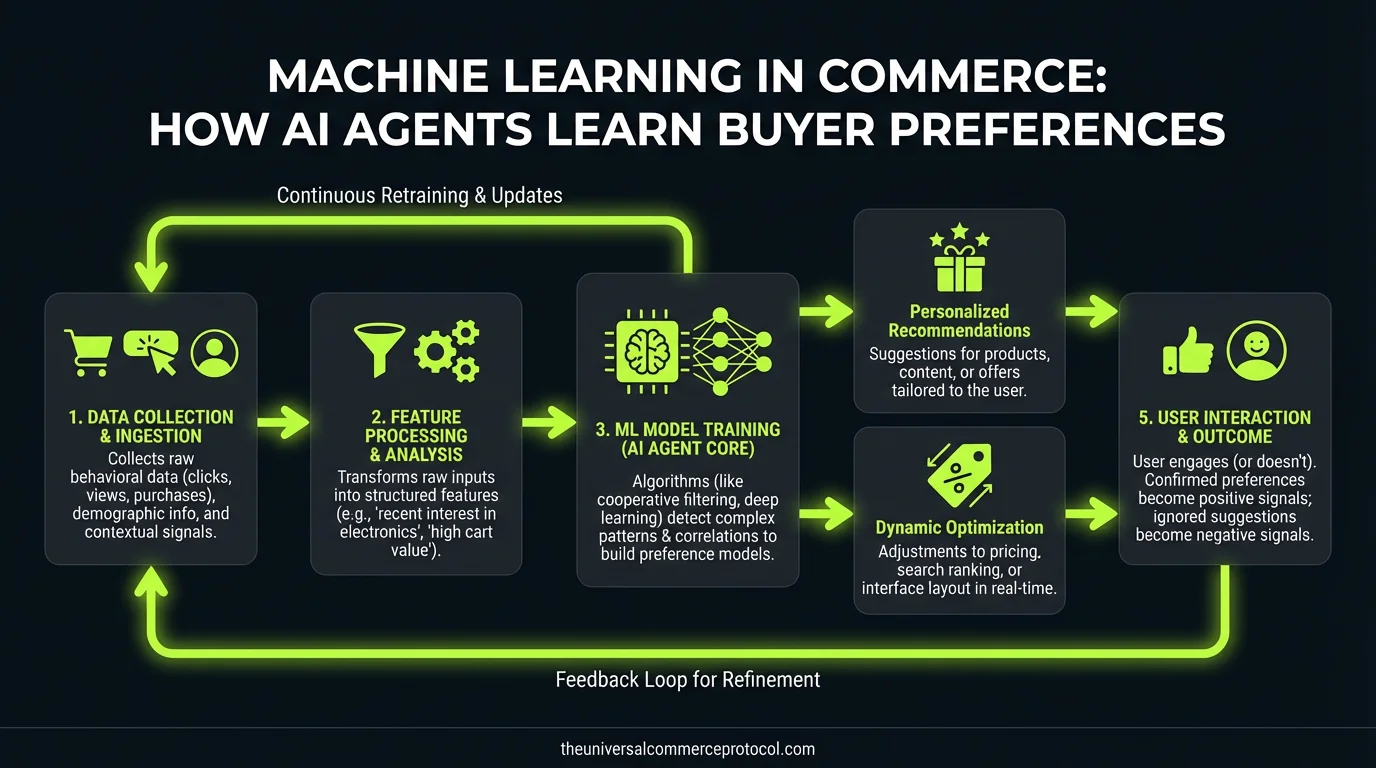
Machine Learning in Commerce: How AI Agents Learn Buyer Preferences
The evolution of e-commerce has reached an inflection point. Rather than customers navigating product catalogs, AI shopping agents now autonomously discover, evaluate, and purchase items aligned with individual preferences. This shift represents a fundamental reimagining of commerce workflows, powered by sophisticated machine learning systems that continuously learn from buyer behavior patterns, transaction histories, and contextual signals.
Within the Universal Commerce Protocol (UCP) ecosystem, machine learning capabilities form the cognitive backbone of agentic commerce—enabling AI agents to make increasingly sophisticated purchasing decisions that mirror human judgment while operating at scale and speed impossible for manual shopping.
The Foundation: How AI Shopping Agents Learn
Behavioral Pattern Recognition
AI shopping agents leverage machine learning to identify patterns across multiple data dimensions. These systems analyze historical purchases, browsing behavior, cart abandonment, product reviews, and even temporal patterns—recognizing that customers may prefer certain product categories during specific seasons or life events.
Companies like Amazon have demonstrated this capability through their recommendation engine, which processes billions of transactions to identify correlations between customer segments and product preferences. Within UCP-compliant systems, similar pattern recognition occurs but with standardized data formats and interoperable protocols, allowing agents to learn across multiple commerce networks simultaneously.
Key learning mechanisms include:
- Collaborative filtering—identifying similarities between customers with comparable purchase histories
- Content-based filtering—analyzing product attributes and matching them to user preferences
- Hybrid approaches—combining multiple signals for enhanced accuracy
- Contextual bandits—optimizing real-time decision-making based on immediate context
Preference Extraction and Representation
Modern AI shopping agents don’t simply memorize purchase history. Instead, they extract latent preference representations—abstract mathematical models encoding what customers actually value beyond explicit transactions.
Embedding techniques, popularized by companies like Shopify and implemented in platforms using TensorFlow and PyTorch frameworks, convert customer behaviors and product attributes into high-dimensional vector spaces. In these spaces, similar customers and products cluster together, enabling agents to make informed recommendations for items customers have never encountered.
For example, an AI shopping agent might learn that a customer who purchases sustainable fashion, eco-friendly home goods, and organic groceries occupies a specific region in preference space. The agent can then identify new products in that region—perhaps a bamboo toothbrush brand or recycled packaging supplies—and autonomously initiate purchases within predefined budget parameters.
Feature Engineering and Signal Weighting
Effective preference learning requires identifying which signals matter most. AI shopping agents employ feature engineering to extract meaningful signals from raw data:
- Purchase frequency and recency (RFM analysis)
- Price sensitivity and elasticity patterns
- Brand loyalty indicators
- Category affinity scores
- Seasonal and lifecycle trends
- Social and peer influence signals
- Product rating and review sentiment
The Universal Commerce Protocol standardizes how these signals are transmitted between systems. Rather than each platform using proprietary formats, UCP-compliant agents exchange preference data through standardized schemas, enabling preference learning to accelerate across the entire commerce network.
Advanced Learning Architectures in Agentic Commerce
Deep Learning and Neural Networks
Sophisticated AI shopping agents employ deep neural networks to capture non-linear relationships in buyer preferences. Deep learning models, particularly recurrent neural networks (RNNs) and transformer architectures, excel at understanding sequential purchasing patterns and long-term preference evolution.
Companies like Alibaba have published research on their deep learning recommendation systems, demonstrating how neural networks can process millions of user-product interactions to generate personalized rankings. These same architectural patterns now power agentic commerce systems where agents must make autonomous decisions without human intervention.
Transformer models, originally developed for natural language processing, have proven particularly effective for commerce applications. They enable agents to understand the contextual importance of different purchase signals—recognizing, for instance, that a recent product review mentioning “durability” should heavily influence recommendations for a customer with a history of purchasing long-lasting goods.
Reinforcement Learning for Purchase Optimization
Beyond supervised learning from historical data, AI shopping agents increasingly employ reinforcement learning—where agents learn optimal purchasing strategies through interaction with the commerce environment.
In reinforcement learning frameworks, agents receive rewards for successful purchases (items retained, high satisfaction scores, repeat purchases) and penalties for poor decisions (returns, negative reviews, budget overruns). Over time, agents develop increasingly sophisticated purchasing policies that maximize long-term customer satisfaction and value.
This approach proves particularly valuable for complex purchasing decisions. An agent might learn that purchasing complementary items together (shoes with socks, laptops with cases) generates higher satisfaction than isolated purchases. Or it might discover that certain customer segments respond better to agent-initiated purchases during specific times of day or after particular life events.
Federated Learning and Privacy-Preserving Preference Models
A critical challenge in agentic commerce involves learning buyer preferences while respecting privacy. Federated learning architectures address this by training preference models across distributed data sources without centralizing sensitive customer information.
Within UCP frameworks, federated learning enables preference models to improve across entire commerce networks while keeping individual customer data within their originating platforms. A customer’s purchase history remains on their preferred commerce platform, yet their learned preferences contribute to improving recommendation models across the network.
This approach aligns with privacy regulations like GDPR and CCPA while enabling the network effects that make agentic commerce powerful. Companies like Google have invested heavily in federated learning infrastructure, and these patterns are now being adopted by commerce platforms seeking to offer agent-driven purchasing without centralizing customer data.
Real-World Applications of Preference Learning in Agentic Commerce
Autonomous Replenishment Systems
Amazon’s Subscribe & Save service represents an early implementation of preference-based autonomous purchasing. AI agents learn replenishment intervals for consumable products, adjusting based on seasonal variations and usage patterns. A customer who purchases coffee every 10 days might see that interval adjust to 8 days during winter months when consumption increases.
Within UCP ecosystems, these replenishment agents operate across multiple retailers and suppliers, learning not just when to repurchase but where to purchase, considering price fluctuations, delivery times, and product availability across the network.
Personalized Shopping Bundles
AI shopping agents learn which product combinations generate maximum satisfaction for specific customer segments. Rather than static bundle offerings, agents dynamically construct personalized bundles based on individual preference models.
A customer interested in fitness might receive agent-curated bundles combining workout equipment, recovery supplements, and fitness tracking devices—with specific products selected based on their demonstrated preferences for brands, price points, and product features.
Predictive Purchasing and Just-In-Time Commerce
Advanced AI shopping agents predict customer needs before customers explicitly express them. By analyzing preference patterns and contextual signals, agents initiate purchases for items customers will likely need soon.
This requires sophisticated preference learning capable of understanding both explicit preferences (products customers have purchased) and implicit preferences (products customers haven’t discovered yet but will likely value). Machine learning models trained on broader customer segments help agents identify these latent preferences.
Cross-Platform Preference Learning
The Universal Commerce Protocol enables AI shopping agents to learn preferences across multiple commerce platforms simultaneously. A customer’s purchases on Shopify stores, Amazon, and niche retailers all contribute to a unified preference model that agents can access.
This network-level preference learning generates powerful effects. Agents gain richer understanding of customer behavior, can identify opportunities across multiple platforms, and can execute purchases through whichever channel offers optimal pricing, availability, or delivery speed.
Challenges and Considerations in Preference Learning
Cold Start Problem
New customers present limited purchase history for preference learning. AI shopping agents address this through collaborative filtering (learning from similar customers) and content-based approaches (analyzing product attributes). Some systems employ hybrid strategies combining multiple approaches to generate reasonable recommendations despite limited data.
Preference Drift and Temporal Dynamics
Customer preferences evolve over time. AI shopping agents must distinguish between temporary fluctuations and genuine preference shifts. Machine learning models employ time-decay functions, giving recent behavior more weight while maintaining historical context.
Balancing Exploitation and Exploration
AI shopping agents face a fundamental tension: should they purchase products aligned with known preferences (exploitation) or explore new products that might reveal expanded preferences (exploration)? Multi-armed bandit algorithms and reinforcement learning frameworks help agents navigate this tradeoff optimally.
Ethical Considerations and Preference Manipulation
As AI shopping agents become more sophisticated at learning preferences, ethical questions emerge about manipulation and autonomy. Agents must operate transparently, allowing customers to understand and adjust learned preferences. UCP frameworks increasingly incorporate governance standards ensuring agents serve customer interests rather than optimizing purely for transaction volume.
The Future of Machine Learning in Agentic Commerce
Machine learning capabilities in AI shopping agents will continue advancing rapidly. Emerging areas include:
- Multimodal preference learning incorporating visual, textual, and behavioral signals
- Causal inference models understanding why customers prefer specific products
- Explainable AI systems that transparently communicate purchase reasoning
- Real-time preference adaptation responding to immediate context and life changes
- Cross-modal learning transferring preferences across product categories
Within the Universal Commerce Protocol, these advances will be standardized and interoperable, allowing preference learning capabilities to benefit entire commerce networks rather than individual platforms.
FAQ
How do AI shopping agents learn buyer preferences without explicit feedback?
AI shopping agents employ implicit feedback signals including purchase history, browsing patterns, time spent on products, cart additions and removals, and product ratings. Machine learning models trained on these signals can infer preferences without requiring customers to explicitly rate items. Advanced agents also incorporate contextual signals like seasonality, life events, and peer behavior to refine preference understanding.
What’s the difference between preference learning in agentic commerce versus traditional recommendation systems?
Traditional recommendation systems suggest products for human review and selection. Agentic commerce systems use learned preferences to make autonomous purchasing decisions within predefined parameters. This requires significantly more sophisticated preference models capable of understanding not just what customers might like, but what they actually want to purchase, at what price points, and under what circumstances.
How does the Universal Commerce Protocol improve preference learning across platforms?
UCP standardizes how preference data and agent instructions are formatted and transmitted between systems. This enables AI shopping agents to access richer preference signals across multiple platforms, learn from broader customer cohorts, and execute purchases through optimal channels—all while maintaining privacy and data security through standardized protocols.
What safeguards prevent AI shopping agents from making poor purchasing decisions?
Effective agentic commerce systems implement multiple safeguards including budget constraints, purchase approval workflows for high-value items, preference override mechanisms allowing customers to reject agent suggestions, regular preference accuracy auditing, and explainability features showing why agents made specific purchasing decisions. UCP frameworks increasingly require these safeguards as standard components of compliant agent implementations.
Frequently Asked Questions
What is the Universal Commerce Protocol (UCP)?
The Universal Commerce Protocol (UCP) is an open standard developed to enable AI agents to autonomously conduct commerce transactions across any platform.
How does UCP enable agentic commerce?
UCP provides standardized APIs and protocols so AI agents can discover products, negotiate terms, and complete purchases without human intervention, working across any compatible commerce platform.
Why should businesses implement UCP?
UCP adoption reduces integration costs, opens revenue channels to AI-driven buyers, and future-proofs commerce infrastructure as agentic purchasing becomes mainstream.
Leave a Reply