Will’s Take is editorial perspective — opinion, future-casting, and industry observation from Will Tygart. Not analysis. Not client work. Just how I see it.
I’ve been thinking about the building piece since I wrote it.
The logic holds — aggregate tenant preferences, go to market as one buyer, change the tier of supplier relationship entirely. But I kept pulling at one thread: why stop at the building?
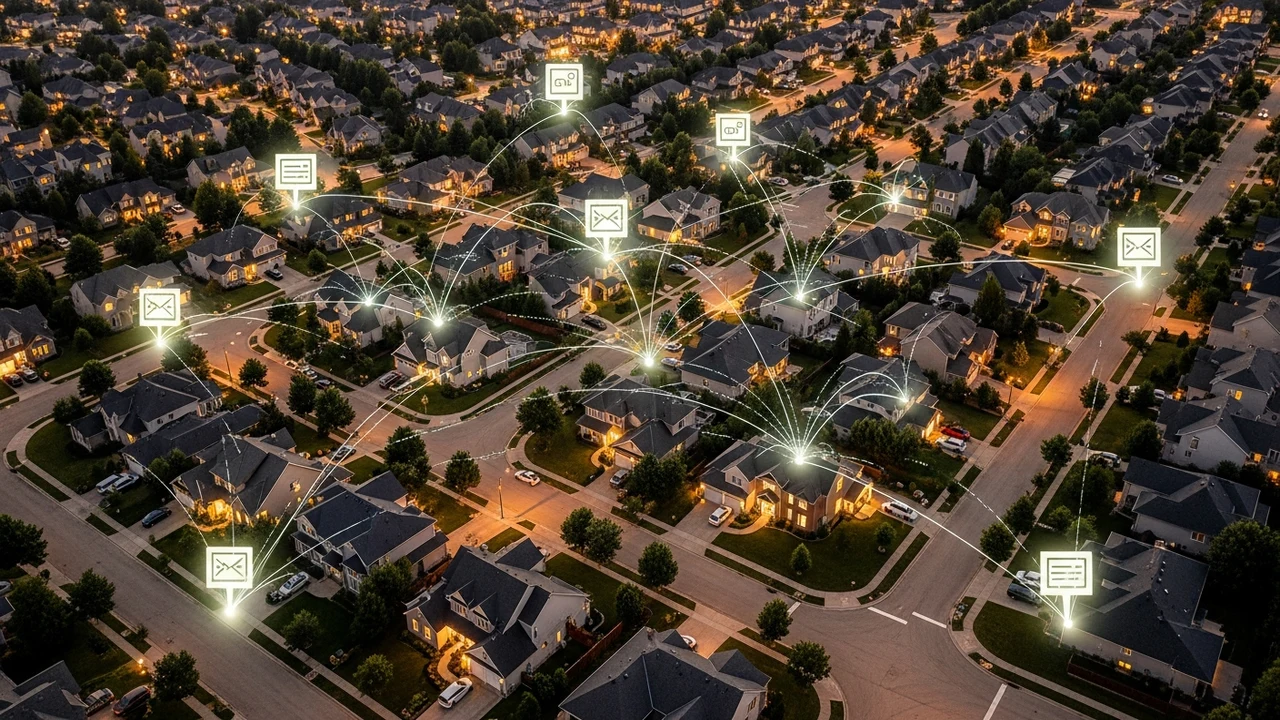
The HOA already exists. The governance structure, the dues collection, the vendor relationships, the shared services. It’s a commerce network that doesn’t know it’s a commerce network. It thinks it’s an administrative body. It spends most of its energy on rule enforcement and meeting minutes and arguing about fence heights.
But underneath all of that is something genuinely interesting: a legally constituted collective of households with shared infrastructure, shared costs, and shared interests. That’s not an HOA problem. That’s a UCP opportunity.
Let me describe what an HOA actually manages.
Landscaping contracts. Pool maintenance. Security services. Common area cleaning. Pest control. Waste management. Exterior painting cycles. Roof maintenance on shared structures. Gate systems. Lighting. In some communities, bulk cable and internet. In others, shared solar or EV charging infrastructure.
Every one of those is a recurring service contract negotiated by a volunteer board on behalf of hundreds of households, usually by whoever has time and is willing to do it, using whatever vendor relationships they inherited from the previous board, with no systematic way to benchmark pricing or evaluate alternatives.
That’s not a governance problem. That’s a commerce infrastructure problem. And it’s the same problem in every HOA in the country, just at different scales.
A UCP-native HOA agent doesn’t replace the board. It gives the board something they’ve never had: actual market intelligence and the ability to act on it systematically.
The shared services layer is the obvious starting point.
Landscaping is the clearest example. A neighborhood with 300 homes is spending meaningful money on landscaping every month. That contract gets negotiated every few years by someone who may or may not know what the market rate actually is, against a vendor who absolutely does.
A neighborhood commerce agent changes that dynamic completely. It knows what comparable neighborhoods in the same zip code are paying. It knows which vendors have capacity right now versus which ones are stretched. It knows seasonal pricing patterns. It can go to market on behalf of the HOA with a structured capability query — here’s the scope, here’s the service frequency, here’s the quality standard, here are the terms we’ll consider — and receive competitive responses from vendors who have published their own profiles.
That’s not a bidding war. That’s a structured market. The vendor knows exactly what the HOA needs. The HOA knows exactly what the market offers. The negotiation starts from a position of information parity instead of the vendor knowing everything and the volunteer board knowing whatever they remember from three years ago.
The individual household layer is where it gets more interesting.
Once the HOA has a commerce infrastructure, the logical extension is connecting it to individual household needs that have neighborhood-level solutions.
Home maintenance is the obvious one. Every homeowner in a community is dealing with the same climate, the same soil, the same aging housing stock, the same local code requirements. The maintenance needs are different in their specifics but similar in their category. A neighborhood agent that understands the housing cohort — age of homes, construction type, common failure points — can surface maintenance opportunities that individual homeowners wouldn’t find on their own.
The HVAC company that’s already doing six units in the neighborhood this month will do yours for less because the mobilization cost is already absorbed. The roofer who knows the specific tile profile used in your development in 1987 is worth finding before you need them urgently. The electrician who understands the panel configuration common to your era of construction is faster and cheaper than one learning on your dime.
That knowledge exists. It just lives in vendor heads and HOA institutional memory and neighborhood Facebook groups. A structured commerce layer surfaces it systematically.
The bulk purchasing angle compounds over time.
An HOA commerce agent that starts with shared services can expand into household purchasing categories where neighborhood-level volume creates real advantage.
Energy is the clearest one. Community solar programs already exist in many markets — households aggregating demand to get better rates on renewable energy. That’s UCP logic applied to utilities before UCP existed. A neighborhood agent formalizes and optimizes that continuously rather than locking it in once every few years.
Insurance is another one. Homeowners in the same neighborhood have similar risk profiles. A neighborhood commerce agent that understands the housing cohort can present a more sophisticated risk package to carriers than individual homeowners can. Not a group policy — carriers don’t generally do that for homeowners — but a coordinated approach to market that gets each household better information and potentially better positioning.
Water. Waste. Internet. In markets where these have competitive options, neighborhood-level negotiation changes the terms. The HOA already pays for common area utilities. Extending that relationship to household utilities is a natural expansion once the commerce infrastructure exists.
The governance piece is actually an asset here, not a complication.
HOAs have something that ad-hoc neighborhood groups don’t: legal standing. They can sign contracts. They can hold funds. They can enforce participation in programs that the community has voted to adopt. They have a governance structure that gives vendors a real counterparty, not just a group of people who might or might not follow through.
That legal standing is what makes the commerce layer work at scale. A vendor offering a neighborhood deal needs to know the commitment is real. An HOA with a UCP agent and a board resolution is a real counterparty. A neighborhood Facebook group is not.
The HOA has been thinking of its governance structure as overhead. It’s actually the foundation of a commerce platform that nobody has built yet.
The resistance is going to come from the same place it always does.
Volunteer boards are risk-averse by nature. They’re not compensated for upside. They’re accountable for downside. Adopting new systems — even ones that clearly benefit residents — requires someone to champion them, someone to learn them, and someone to take responsibility when something goes wrong.
That’s a real friction. It’s not insurmountable but it means the early adopters are going to be professionally managed HOAs in larger communities, not the three-person volunteer board running a 40-unit townhome association.
The larger managed communities will prove the model. The smaller ones will follow when the software is simple enough that you don’t need to understand how it works, just what it does.
That’s how every infrastructure technology gets adopted. It starts where the capacity to absorb complexity exists. It reaches everyone else when the complexity gets abstracted away.
The HOA is a sleeping commerce network.
It has the volume, the legal standing, the recurring relationships, and the shared interests. It’s missing the protocol layer that connects all of that into something that goes to market intelligently on behalf of the people inside it.
That’s a solvable problem. And when it gets solved, the HOA stops being the thing everyone dreads getting a letter from and starts being the thing that actually makes owning a home in a community meaningfully cheaper and easier.
That’s a different value proposition than enforcing fence heights.
Frequently Asked Questions
What is the Universal Commerce Protocol (UCP)?
The Universal Commerce Protocol (UCP) is an open standard developed to enable AI agents to autonomously conduct commerce transactions across any platform.
How does UCP enable agentic commerce?
UCP provides standardized APIs and protocols so AI agents can discover products, negotiate terms, and complete purchases without human intervention, working across any compatible commerce platform.
Why should businesses implement UCP?
UCP adoption reduces integration costs, opens revenue channels to AI-driven buyers, and future-proofs commerce infrastructure as agentic purchasing becomes mainstream.
Leave a Reply