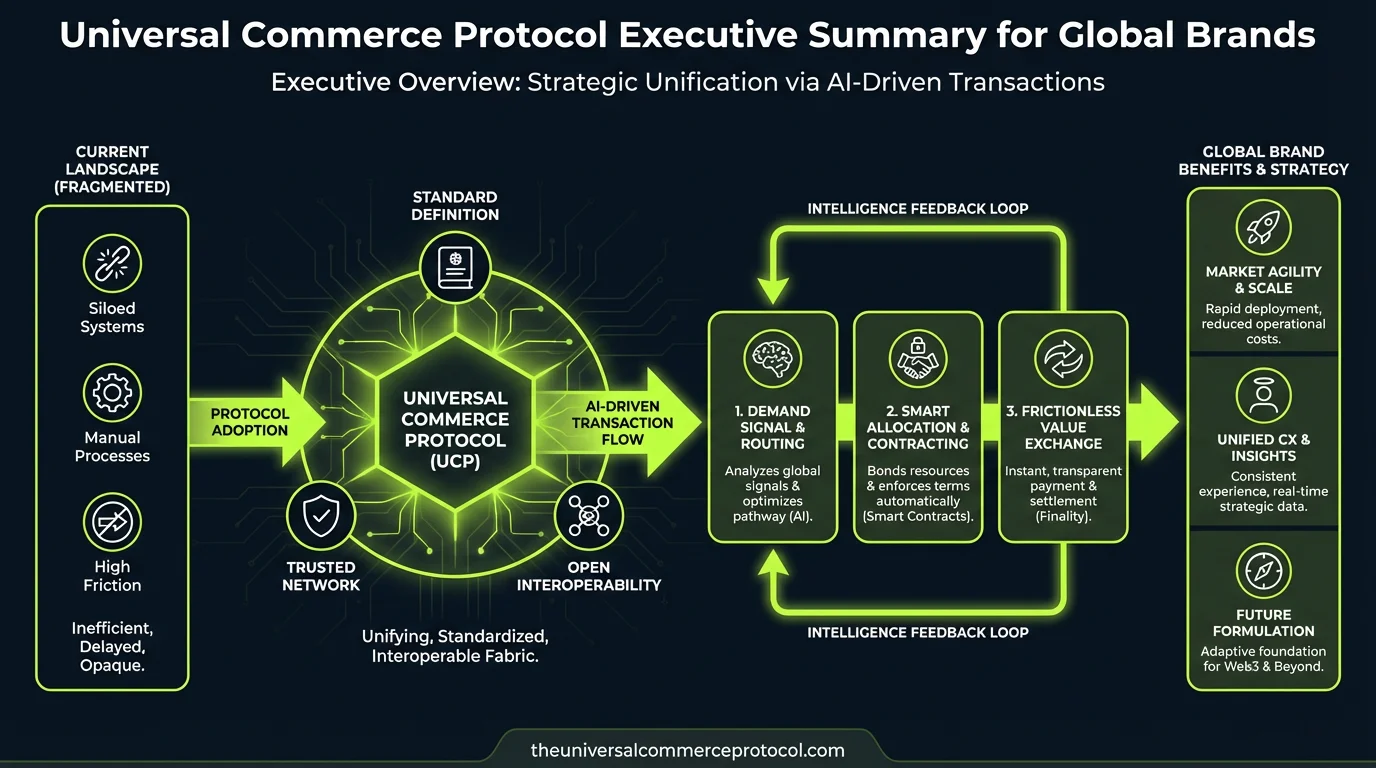
Universal Commerce Protocol: The Executive Summary for Global Brands
The landscape of global commerce is shifting from a user-centric model to an agentic one. For decades, brands have optimized for human eyes, focusing on search engine optimization (SEO), user experience (UX) design, and the psychological triggers of the conversion funnel. However, as Large Language Models (LLMs) like Google Gemini begin to act as autonomous representatives for consumers, the standard for success is no longer visual appeal—it is machine-readability. The Universal Commerce Protocol (UCP) is the foundational interoperability layer that enables this transition. For CEOs and digital leaders, UCP is not just another technical standard; it is the infrastructure required to survive and thrive in an era of agentic commerce.
Why UCP Matters for CEOs
In the traditional retail model, the brand controls the environment. A customer visits a website, navigates a proprietary menu, and follows a hard-coded path to purchase. This model is increasingly inefficient. The Customer Acquisition Cost (CAC) is soaring as platforms become saturated, and the complexity of the global supply chain makes real-time inventory management a constant struggle. UCP solves these systemic issues by decentralizing the storefront. By implementing UCP, a brand ensures that its inventory, pricing, and checkout capabilities are accessible to AI agents anywhere in the digital ecosystem.
For the executive leadership, the value proposition of UCP is threefold: first, it reduces friction by enabling instant transactions; second, it future-proofs the brand against the decline of traditional search; and third, it leverages existing investments in the Google ecosystem. Rather than rebuilding their entire e-commerce stack, brands can layer UCP on top of their current infrastructure to create a bridge to the future of autonomous retail.
The Friction Gap
The ‘Friction Gap’ refers to the loss of potential revenue that occurs between a customer’s initial intent and the final completion of a purchase. In standard e-commerce, this gap is filled with high-friction tasks: creating accounts, entering credit card details, calculating shipping costs, and navigating through multiple pages. Current data suggests that even a one-second delay in page load time can reduce conversions by 7%, and cart abandonment rates remain stubbornly high at nearly 70%.
UCP eliminates this gap by replacing manual UI interactions with standardized API calls. Instead of a human customer filling out a form, an AI agent using the Model Context Protocol (MCP) communicates directly with the brand’s server. Because the agent already possesses the user’s preferences, payment credentials (via Google Pay), and shipping address, the transaction can be finalized in milliseconds. This is the essence of ‘Zero-Click Commerce.’ For global brands, minimizing this friction is the single most effective way to improve the bottom line in a competitive market.
The Discovery Engine (Gemini)
The discovery phase of the consumer journey is being revolutionized by Google Gemini and its integration with the Google Merchant Center. Traditionally, discovery was limited by keywords and metadata. In the UCP-enabled world, discovery is driven by reasoning. When a user asks Gemini, ‘Find me a high-quality leather briefcase available for overnight delivery to New York,’ the AI does not just return a list of links. It identifies merchants who support the UCP standard via the /.well-known/ucp endpoint.
This endpoint acts as a digital passport for the merchant, informing the AI agent that the store is ‘UCP-Ready.’ The agent then queries the brand’s product feeds within the Google Merchant Center to verify real-time inventory and pricing. By utilizing Supplemental Feeds and Eligibility Signals, brands can flag specific products as available for agentic purchase. This creates a powerful synergy: Google Merchant Center handles the data storage and product discovery, while UCP handles the transaction logic. This integration ensures that a brand’s products are not just seen by consumers, but are actionable for their AI agents.
The Role of MCP (Model Context Protocol)
The Model Context Protocol (MCP) serves as the secure communication channel between the AI model (Gemini) and the merchant’s backend. In the UCP framework, MCP allows Gemini to understand the specific capabilities of a store—such as whether it supports Native Checkout or requires an Embedded path. By standardizing these interactions, UCP ensures that the brand maintains control over its data while allowing the agent to provide a seamless user experience. This protocol-based approach prevents the ‘walled garden’ effect, allowing brands to reach customers across various AI interfaces without having to develop unique integrations for each one.
Future-Proofing with Native Checkout
One of the most critical decisions a brand will make in the next 24 months is whether to prioritize Native or Embedded checkout paths. Embedded checkout refers to the legacy model where an agent directs a user back to a webview to complete a purchase. While familiar, this path reintroduces the friction that UCP aims to eliminate. Native Checkout, on the other hand, allows the AI agent to execute the transaction entirely within the conversational interface.
Native Checkout is powered by Google Pay and secure identity linking. Through OAuth 2.0, the user’s identity is securely connected to the merchant’s system, allowing for personalized pricing, loyalty point application, and one-click execution. To mitigate risk, UCP utilizes Risk Signals and identity verification to ensure that every agentic transaction is legitimate. For global brands, the implementation of Native Checkout represents the ultimate competitive advantage. It allows the brand to act as the Merchant of Record while the AI agent acts as the highly efficient salesperson.
Implementation Table: The Roadmap to UCP Adoption
| Phase | Focus Area | Key Technologies | Outcome |
|---|---|---|---|
| 1. Discovery | Enable AI Visibility | /.well-known/ucp, Google Merchant Center | Brand is discoverable by Gemini and other agents. |
| 2. Integration | Connect Identity & Payment | OAuth 2.0, Google Pay, MCP | Secure linking of user accounts and payment methods. |
| 3. Execution | Native Checkout Launch | UCP REST API, Webhooks | Full agentic commerce capability with zero-click checkout. |
| 4. Optimization | Advanced Signals | Risk Signals, California Prop 65, Supplemental Feeds | Global compliance and enhanced conversion through data accuracy. |
As we look toward the 2030 economy, the brands that dominate will not be those with the flashiest websites, but those with the most accessible protocols. The Universal Commerce Protocol provides the blueprint for this transition. By aligning with Google’s robust ecosystem—from the reasoning power of Gemini to the ubiquity of Google Pay—global brands can capture the first-mover advantage in the age of agentic commerce. The time for experimentation has passed; the time for implementation is now. CEOs who prioritize UCP today are investing in the long-term scalability and relevance of their brands in an autonomous world.
🎙️ The UCP Brief — Audio Summary
Read transcript
Welcome to The UCP Brief. Today we’re diving into the Universal Commerce Protocol, or UCP, and why it’s not just another tech buzzword. Forget optimizing solely for human eyeballs. The game has changed. With AI agents like Google’s Gemini acting as autonomous shoppers, machine readability is now paramount. UCP is the foundational layer that makes this agentic commerce possible.
Think about the traditional online shopping experience. It’s clunky, right? Navigating menus, creating accounts, entering credit card details. Customer acquisition costs are soaring, and managing global supply chains is a nightmare. UCP decentralizes the storefront, making your inventory and pricing accessible to AI agents across the entire digital landscape. This means less friction, future-proofing against the decline of traditional search, and leveraging your existing Google investments.
The real power of UCP lies in closing the “Friction Gap.” This is the revenue lost between a customer’s initial intent and the final purchase. Current e-commerce is riddled with friction: slow load times, high cart abandonment rates. UCP eliminates this by enabling AI agents to communicate directly with your servers, using pre-existing user data for near-instant transactions. We’re talking zero-click commerce, folks. And for global brands, minimizing this friction is the single most effective way to boost the bottom line.
I’m Will Tygart. Stay curious.
Frequently Asked Questions
What is the Universal Commerce Protocol (UCP)?
The Universal Commerce Protocol is a foundational interoperability layer that enables commerce in an agentic ecosystem. It allows brands to make their inventory, pricing, and checkout capabilities machine-readable and accessible to AI agents, shifting from a traditional user-centric model to one optimized for autonomous digital representatives like LLMs.
How does UCP differ from traditional e-commerce models?
Traditional e-commerce focuses on optimizing for human users through SEO, UX design, and conversion psychology. UCP, however, prioritizes machine-readability and enables decentralized storefronts where AI agents can access brand data directly. This eliminates the need for customers to navigate proprietary websites and hard-coded purchase paths.
Why should CEOs care about implementing UCP?
For executives, UCP is critical infrastructure for the era of agentic commerce. It helps reduce Customer Acquisition Cost (CAC) by making brands discoverable to AI agents, simplifies real-time inventory management, and ensures your brand remains competitive as Large Language Models increasingly act as autonomous consumer representatives.
What business problems does UCP solve?
UCP addresses soaring customer acquisition costs, platform saturation, complex global supply chain management, and the inefficiencies of proprietary storefronts. By decentralizing access to inventory and pricing data, it enables brands to reach customers through multiple AI-powered channels simultaneously.
How does UCP prepare brands for AI-driven commerce?
As Large Language Models like Google Gemini begin acting as autonomous agents for consumers, UCP ensures your brand’s data is accessible and properly formatted for machine interpretation. This positions brands to thrive in an ecosystem where AI agents, not human browsing, drive commerce interactions.
Related: Configure /.well-known/ucp Discovery Endpoint for AI
Frequently Asked Questions
What is the Universal Commerce Protocol (UCP)?
The Universal Commerce Protocol (UCP) is an open standard developed to enable AI agents to autonomously conduct commerce transactions across any platform.
How does UCP enable agentic commerce?
UCP provides standardized APIs and protocols so AI agents can discover products, negotiate terms, and complete purchases without human intervention, working across any compatible commerce platform.
Why should businesses implement UCP?
UCP adoption reduces integration costs, opens revenue channels to AI-driven buyers, and future-proofs commerce infrastructure as agentic purchasing becomes mainstream.
Leave a Reply