The Liability Shift in AI Commerce
As we transition from traditional e-commerce to a landscape dominated by agentic commerce, the definition of the ‘seller’ is undergoing a fundamental transformation. For Compliance Officers, the primary concern is no longer just the transaction itself, but the legal liability of the entities facilitating it. In the context of the Universal Commerce Protocol (UCP), the Merchant of Record (MoR) serves as the critical legal layer that bridges the gap between a stateless AI agent—like a Google Gemini-powered shopping assistant—and the complex, localized web of global trade regulations.
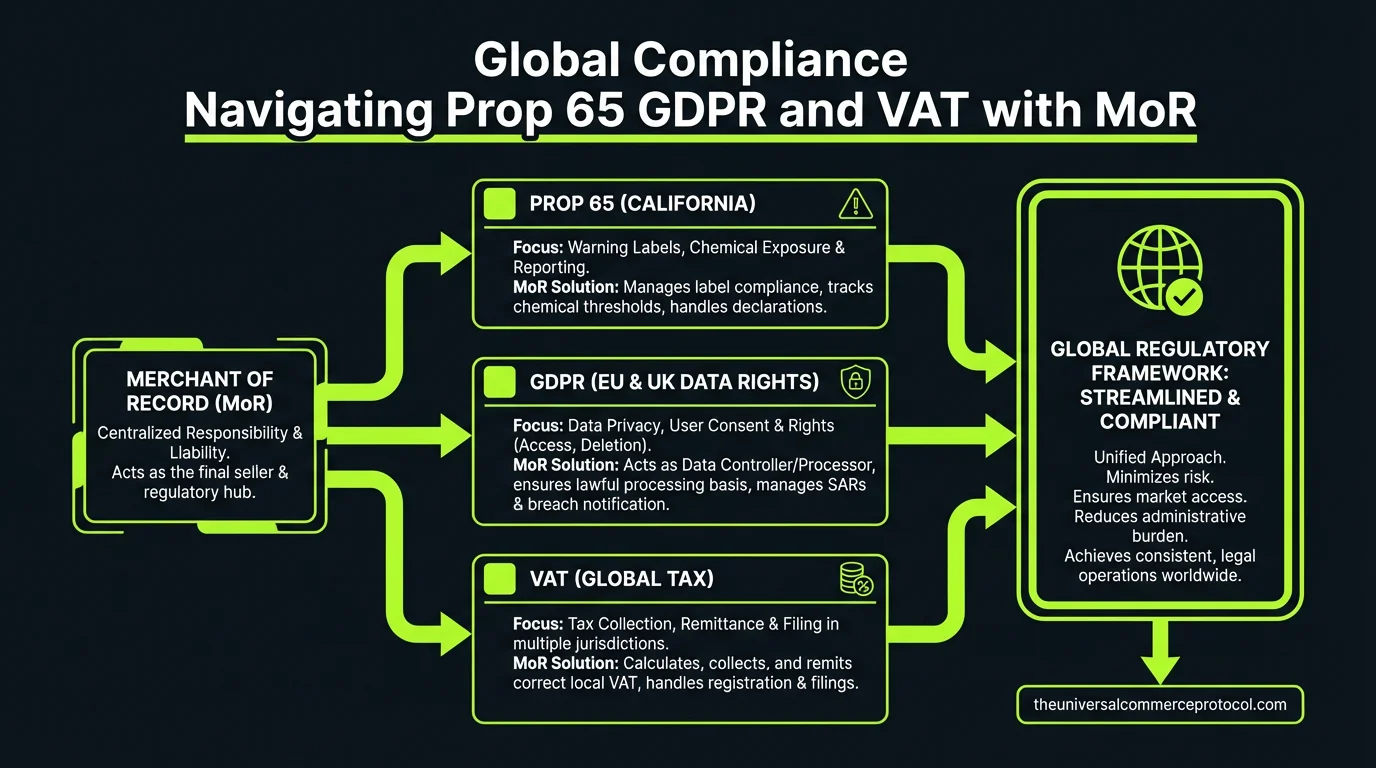
Traditional commerce models require the end-user to navigate the compliance landscape: reading disclosures, calculating regional taxes, and ensuring the product is legal in their jurisdiction. In an agentic workflow, the agent executes these tasks. However, the agent itself cannot be held legally liable in a court of law. This is where the MoR model within UCP becomes indispensable. By acting as the seller of record, the MoR assumes responsibility for VAT collection, GDPR data processing, and consumer safety disclosures, allowing the AI agent to operate within a ‘safety envelope’ of pre-verified compliance.
The Merchant of Record in the UCP Framework
Within the UCP ecosystem, the Merchant of Record is the entity that maintains the financial relationship with the banking system and the legal relationship with the consumer. When a user instructs a Gemini agent to ‘buy the most sustainable ergonomic chair available,’ the agent utilizes the Model Context Protocol (MCP) to query product feeds via Google Merchant Center. However, the actual transaction logic—the moment the ‘buy’ signal is triggered—is routed through the MoR.
Native vs. Embedded Checkout Compliance
UCP supports two primary checkout paths, each with distinct compliance profiles:
- Native Checkout: The transaction occurs directly within the agent’s interface (e.g., inside a Google Pay-enabled chat). Here, the MoR’s logic is deeply integrated into the UCP payload, ensuring that all regional disclosures are presented as part of the agent’s natural language response.
- Embedded Checkout: The agent renders a secure web view from the merchant. While this offloads some risk, it creates friction. For high-compliance sectors, UCP prioritizes Native Checkout backed by an MoR to maintain a seamless user experience without sacrificing legal rigor.
Automated Tax Calculation
One of the most significant hurdles in global commerce is the fragmented nature of consumption taxes. Whether it is VAT in the EU, GST in Australia, or the labyrinthine sales tax nexus in the United States, the MoR infrastructure within UCP automates this via real-time hooks into Google Merchant Center’s tax engines.
| Region | Tax Responsibility | UCP Automation Logic |
|---|---|---|
| European Union | VAT Compliance | Real-time calculation based on the shipping destination and the MoR’s VAT ID. |
| United States | Sales Tax Nexus | Dynamic calculation using Zip+4 precision via integrated tax APIs. |
| Cross-Border | Import Duties | Automatic inclusion of de minimis thresholds and duty estimations in the total landed cost. |
By leveraging Google Merchant Center’s supplemental feeds, UCP can inject real-time tax data directly into the JSON-RPC call that the agent receives. This ensures that when an agent presents a ‘Total Price’ to a user, that price is inclusive of all legal financial obligations, preventing the ‘sticker shock’ that often leads to cart abandonment and regulatory scrutiny.
Managing Regional Disclosures: Prop 65 and Beyond
California’s Proposition 65 is a prime example of a ‘high-stakes’ regional disclosure. Failure to provide a ‘clear and reasonable warning’ for products containing specific chemicals can result in massive litigation. For an AI agent, missing this disclosure is a significant risk. Within UCP, these disclosures are treated as mandatory metadata fields. When a product is indexed through the Google Merchant Center and flagged for Prop 65, the UCP server forces the inclusion of this warning in the transaction payload.
GDPR and Data Sovereignty
Under GDPR, the MoR acts as the Data Controller for the transaction. UCP facilitates this by using Identity Linking and OAuth 2.0 to ensure that the AI agent only accesses the minimum necessary PII (Personally Identifiable Information) required to complete the purchase. The MoR manages the storage of transaction records, right-to-be-forgotten requests, and data residency requirements, shielding the developer of the AI agent from the complexities of international data privacy law.
The Role of MoR in Agent Safety
Agent safety is not just about preventing an AI from hallucinating; it is about preventing an AI from committing a legal error. The Merchant of Record serves as a ‘Compliance Firewall.’ Before a transaction is finalized via Google Pay, the UCP protocol runs a series of validation checks:
- Eligibility Signals: Is the product restricted in the destination country (e.g., CBD, certain electronics)?
- Risk Signals: Does the transaction pattern suggest fraudulent behavior or a hijacked agent session?
- Disclosure Verification: Has the user (or the agent on the user’s behalf) acknowledged the necessary legal terms?
By centralizing these checks within the MoR, UCP ensures that the agentic ecosystem remains robust and trustworthy. For Compliance Officers, this means that instead of auditing thousands of individual AI behaviors, they only need to audit the MoR’s implementation of the UCP standard.
Integrating with Google AI Model (Gemini)
To make compliance human-readable, UCP utilizes Gemini to translate complex legal jargon into understandable summaries for the end-user. For instance, if a Prop 65 warning is triggered, the agent doesn’t just display a block of text; it explains: ‘Note: This product contains materials that require a specific safety warning in California. You can read the full disclosure here.’ This transparency is powered by the seamless flow of data from the Merchant Center through the UCP to the LLM via MCP.
Conclusion: The Future of Frictionless, Compliant Trade
The Universal Commerce Protocol is designed to make the world a single, programmable marketplace. However, this vision is only possible if legal compliance is as automated as the commerce itself. By elevating the Merchant of Record to a core architectural component, UCP provides Compliance Officers with the tools they need to manage risk in the age of AI. Through automated tax calculation, rigorous regional disclosures, and the strategic use of Google’s commerce stack, UCP ensures that agentic commerce is not just fast, but fundamentally legal and safe for all parties involved.
🎙️ The UCP Brief — Audio Summary
Read transcript
Welcome to The UCP Brief.
Today we’re diving deep into global compliance within the Universal Commerce Protocol, or UCP. The rise of AI agents handling our transactions is shifting who’s actually responsible when things go wrong. Think about it: if your Google Gemini agent buys something that violates Prop 65 in California, who gets the blame? It’s not the AI; it’s the Merchant of Record, or MoR.
The MoR in the UCP ecosystem acts as that crucial legal shield. They’re the ones holding the financial relationship with the banks and the legal relationship with you, the consumer. So when your AI assistant buys that “most sustainable ergonomic chair,” the MoR is ensuring VAT is collected properly and GDPR data processing is followed to the letter.
UCP offers two checkout paths, native and embedded. Native checkout is where the magic really happens. The MoR’s logic is baked right into the agent’s interface, making sure all those regional disclosures are presented in plain language. This is especially important for high-compliance sectors, where seamless user experience can’t come at the expense of legal rigor.
And let’s not forget about the nightmare that is global tax calculation. VAT, GST, US sales tax nexus—it’s a mess. But the UCP’s MoR infrastructure automates all of this, tapping into Google Merchant Center’s tax engines in real-time. This ensures accurate tax collection no matter where the product is being shipped.
I’m Will Tygart. Stay curious.
What is a Merchant of Record (MoR) and why is it important in AI commerce?
A Merchant of Record is the legal entity responsible for processing transactions and assuming liability for compliance obligations in agentic commerce. Since AI agents cannot be held legally liable, the MoR serves as the critical legal layer that bridges stateless AI agents (like shopping assistants) with global trade regulations, assuming responsibility for VAT collection, GDPR compliance, and consumer safety disclosures.
How does the Merchant of Record handle VAT and tax compliance?
The MoR is responsible for calculating and collecting VAT based on the customer’s location and jurisdiction. By taking on this duty, the MoR ensures that AI agents can operate within a pre-verified compliance framework without needing to navigate complex regional tax requirements themselves, simplifying the transaction process.
What is the relationship between MoR and GDPR compliance?
As the Merchant of Record, the entity assumes legal responsibility for GDPR data processing obligations. This means the MoR handles customer data protection, privacy disclosures, and regulatory compliance related to personal data collection and processing in the AI commerce workflow.
How does the Universal Commerce Protocol (UCP) framework support MoR functions?
The UCP framework establishes the MoR as a critical component that maintains both financial relationships with banking systems and legal relationships with consumers. This framework creates a ‘safety envelope’ allowing AI agents to operate efficiently while the MoR handles all compliance responsibilities and regulatory obligations.
What liability responsibilities does a Merchant of Record assume?
The MoR assumes comprehensive liability including Prop 65 consumer safety disclosures, VAT collection and remittance, GDPR data processing obligations, and the legal responsibility for transactions facilitated by AI agents. This protects both the AI agent and the end-user within a compliant transaction framework.
Leave a Reply