The Convergence of Agentic Commerce and Technical Strategy
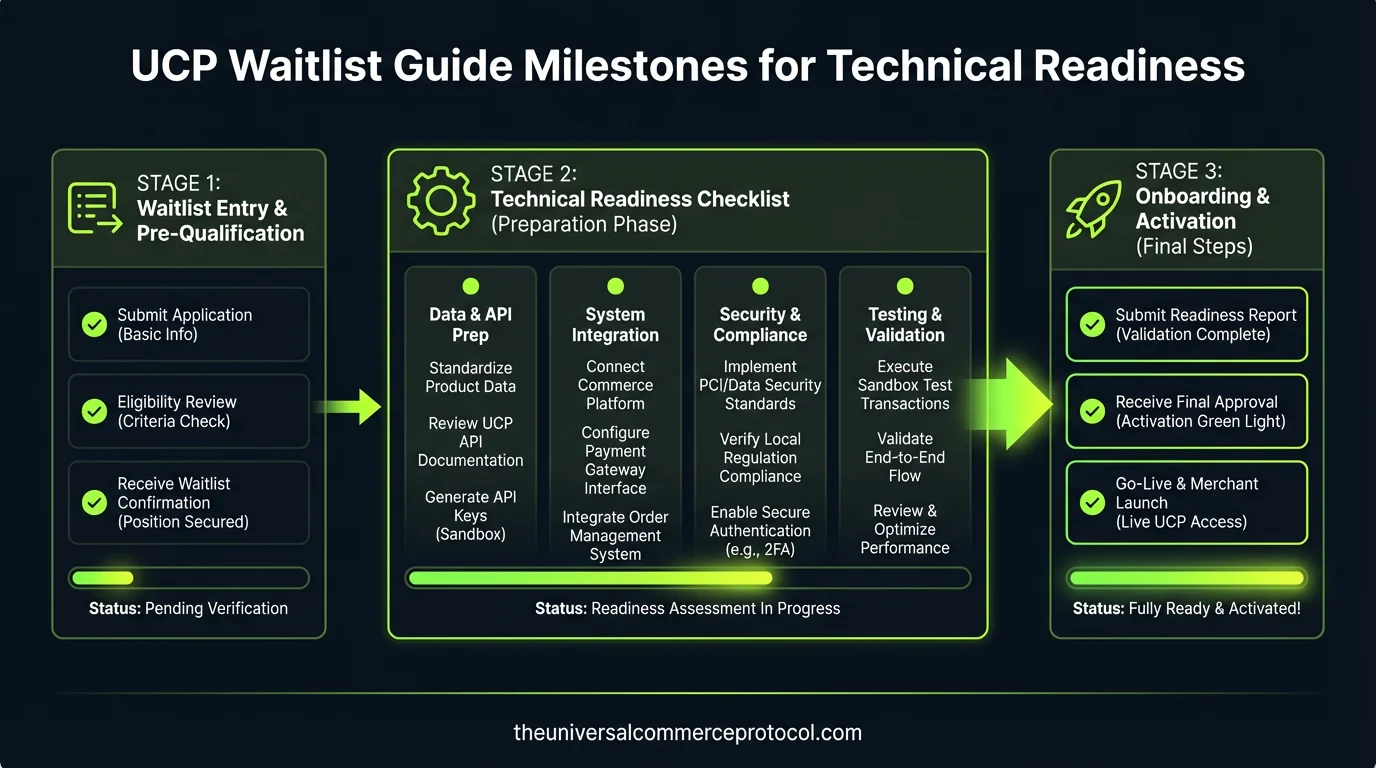
As the commerce landscape shifts from search-and-click to agentic discovery, Chief Technology Officers must prepare their infrastructure for a world where AI agents, not just human users, are the primary purchasers. The Universal Commerce Protocol (UCP) is the bridge between traditional e-commerce backends and the emerging AI ecosystem led by Google Gemini. For merchants on the UCP waitlist, the transition from ‘registered’ to ‘active pilot’ depends on achieving specific technical milestones. This guide outlines the UCP Technical Readiness requirements, focusing on the integration of Google tools and the Model Context Protocol (MCP).
The Three Pillars of Readiness
Technical readiness for UCP is not merely about API connectivity; it is about data legibility and transactional sovereignty. We categorize these requirements into three distinct pillars: Data Integrity, Connectivity Infrastructure, and Compliance Architecture.
1. Data Integrity via Google Merchant Center
AI agents, specifically those powered by Google Gemini, rely on high-fidelity structured data to make purchasing decisions. Your existing Product Feeds in Google Merchant Center (GMC) are the source of truth. UCP Technical Readiness requires that these feeds are optimized for ‘AI Mode’ consumption, meaning attributes must go beyond basic SKU data to include rich context, material composition, and real-time availability signals.
2. Connectivity and Discovery
For an AI agent to interact with your store, it must first ‘discover’ your UCP capabilities. This is achieved through the configuration of the /.well-known/ucp discovery endpoint. This JSON-based manifest tells the UCP network which checkout paths you support (Native vs. Embedded) and provides the necessary REST API endpoints for the Model Context Protocol (MCP) to fetch real-time state changes.
3. Transactional Sovereignty and Google Pay
The final pillar involves the actual movement of funds. CTOs must evaluate their current checkout flow to determine if they can support Native Checkout—where the agent completes the transaction on behalf of the user using Google Pay and UCP’s identity linking—or if they must rely on Embedded Checkout (a browser-based handoff). Readiness here involves auditing your Merchant of Record (MoR) partnerships to ensure they can handle cross-border tax and compliance logic transmitted via UCP signals.
Audit Your Data Infrastructure
The first milestone in the UCP Technical Readiness checklist is an audit of your Google-platform data pipelines. In the age of agentic commerce, your data infrastructure is your storefront.
Optimizing Supplemental Feeds
Standard product feeds often lack the nuance required for autonomous agents to verify compatibility or ethical compliance. Use Google Merchant Center Supplemental Feeds to inject UCP-specific attributes. This includes California Prop 65 warnings, detailed sustainability certifications, and ‘Eligibility Signals’ that tell an agent whether a product can be shipped to a specific jurisdiction under current local laws.
Gemini and the Semantic Layer
When Gemini processes a merchant’s catalog through UCP, it isn’t just looking for keywords; it is building a semantic model of the inventory. CTOs should ensure that their backend systems can generate JSON-LD metadata that aligns perfectly with their GMC feeds. Any discrepancy between the data an agent sees in a ‘search context’ and the data it finds at the ‘checkout context’ will result in a trust-score penalty within the UCP network.
| Readiness Component | Google Tooling | Technical Requirement |
|---|---|---|
| Product Discovery | Google Merchant Center | High-fidelity feed with 98%+ attribute coverage. |
| Identity & Payment | Google Pay / OAuth 2.0 | Integration of Risk Signals and Identity Linking. |
| Agent Communication | Gemini / MCP | Deployment of REST API with JSON-RPC support. |
Setting Up the UCP Developer Sandbox
Once your data is audited, the next phase of UCP Technical Readiness is the implementation of the communication layer. This involves moving beyond static web pages toward a dynamic API-first architecture.
Configuring the Discovery Endpoint
The /.well-known/ucp file is the entry point for all agentic interactions. It must be hosted on your primary domain and be accessible without authentication. This manifest includes pointers to your OAuth 2.0 authorization servers and your MCP server address. This allows the Universal Commerce Protocol to verify your merchant identity and understand your supported features (e.g., whether you support fractional payments or recurring subscriptions).
Native vs. Embedded Checkout Paths
A critical decision for any CTO is the selection of the primary checkout path. UCP supports two distinct modes:
- Native Checkout: The agent remains in its own interface (e.g., Google AI Mode). It uses the UCP API to fetch shipping rates, apply discounts, and submit payment via a Google Pay token. This offers the highest conversion rate but requires a deep integration with your order management system (OMS).
- Embedded Checkout: The agent prepares the cart but hands the user off to a ‘headless’ version of your checkout page. This is easier to implement initially but creates more friction in the agentic flow.
Implementing the Model Context Protocol (MCP)
The Model Context Protocol is the standardized way for LLMs like Gemini to interact with local or remote data sources. For UCP, you must implement an MCP server that acts as a translator between the agent’s natural language intent and your backend REST API. This server handles ‘tools’ such as get_product_availability, calculate_shipping, and validate_coupon. Security is paramount here; all MCP requests must be signed and verified using the merchant’s public/private key pair registered on the UCP waitlist.
Merchant of Record (MoR) and Global Compliance
Technical readiness is incomplete without a plan for compliance. Agentic commerce often involves cross-border transactions where the buyer is an AI. This introduces complex legal questions regarding intent and liability. Merchants must ensure their MoR partner is ‘UCP-aware,’ meaning they can ingest UCP’s Risk Signals. These signals provide metadata about the agent’s origin and the user’s verified identity, helping to mitigate fraud in a world where transactions happen at the speed of an API call.
The Role of Webhooks and Real-Time Inventory
Finally, to maintain a ‘Technical Readiness’ status, merchants must implement robust Webhooks. When an agent places an item in a persistent cart, your system must be able to push updates to the UCP network if the price changes or stock levels drop. This ‘Push-Mode’ inventory management prevents agentic errors and ensures a seamless user experience across the Google ecosystem.
Conclusion: Moving to the Pilot Phase
Achieving UCP Technical Readiness is a multi-month journey that requires alignment between data science, DevOps, and legal teams. By focusing on the refinement of Google Merchant Center data, the deployment of the /.well-known/ucp endpoint, and the adoption of the Model Context Protocol, CTOs can position their organizations at the forefront of the agentic revolution. Once these milestones are met and verified by the UCP sandbox, merchants move from the waitlist into the active pilot phase, gaining early access to the millions of users interacting with Google’s next generation of AI-driven commerce tools.
🎙️ The UCP Brief — Audio Summary
Read transcript
Welcome to The UCP Brief.
Today we’re diving into the technical roadmap for merchants eager to join the Universal Commerce Protocol, or UCP. Think of UCP as the on-ramp for AI agents like Google Gemini to autonomously buy and sell on your behalf. And the key takeaway? Getting off the waitlist and into the active pilot program hinges on some pretty specific technical milestones.
The big picture here is that UCP readiness isn’t just about connecting to some new APIs. It’s about fundamentally rethinking your data. AI agents need high-fidelity, structured data to make informed purchasing decisions. So, your Google Merchant Center product feeds, they’re no longer just for humans, they need to be optimized for AI consumption with richer context like material composition and real-time availability.
And finally, it all comes down to the transaction itself. CTOs need to assess their checkout flows to support either native checkout, where the AI agent completes the purchase with Google Pay, or embedded checkout, which is the more traditional browser-based handoff. Either way, you need to make sure your Merchant of Record partnerships can handle the cross-border tax and compliance logic that UCP throws their way.
I’m Will Tygart. Stay curious.
What is the Universal Commerce Protocol (UCP) and why does it matter for my business?
The Universal Commerce Protocol (UCP) is a bridge between traditional e-commerce backends and the emerging AI ecosystem, particularly Google Gemini. As commerce shifts from search-and-click to agentic discovery, UCP enables AI agents to become primary purchasers on your platform. This makes it essential for CTOs preparing their infrastructure for the future of AI-driven commerce.
What are the three pillars of UCP technical readiness?
The three pillars of technical readiness for UCP are: (1) Data Integrity via Google Merchant Center – ensuring high-fidelity structured data for AI agent decision-making, (2) Connectivity Infrastructure – establishing seamless API connections between your systems and the UCP ecosystem, and (3) Compliance Architecture – meeting security and regulatory requirements for agentic transactions.
What role does Google Merchant Center play in UCP readiness?
Google Merchant Center serves as the source of truth for your product data in the UCP ecosystem. Your Product Feeds must be optimized for ‘AI Mode’ consumption, going beyond basic SKU data to include rich context such as material composition, real-time availability, and other attributes that help AI agents make informed purchasing decisions.
What is the Model Context Protocol (MCP) and how does it relate to UCP?
The Model Context Protocol (MCP) is a key integration component for achieving UCP technical readiness. It works alongside Google tools to enable seamless communication between your commerce infrastructure and AI agents, facilitating the transactional sovereignty needed for agentic commerce.
How do I move from ‘registered’ to ‘active pilot’ status on the UCP waitlist?
Progressing from ‘registered’ to ‘active pilot’ status depends on achieving specific technical milestones across the three pillars of readiness: Data Integrity, Connectivity Infrastructure, and Compliance Architecture. This guide provides the detailed requirements needed to meet these milestones and advance in the UCP program.
Leave a Reply