Will’s Take is editorial perspective — opinion, future-casting, and industry observation from Will Tygart. Not analysis. Not client work. Just how I see it.
Every piece I’ve written in this series has an insurance carrier somewhere in the background.
The restoration job that books itself — the carrier is generating the FNOL. The broker who dies last — the carrier is the counterparty the broker is translating for. The trust problem when an AI books your plumber — the carrier is the entity that already does exactly that, assigning preferred contractors without homeowner input.
I kept putting the carrier in the background because I was writing about other things. But the carrier isn’t background. It’s the center of gravity.
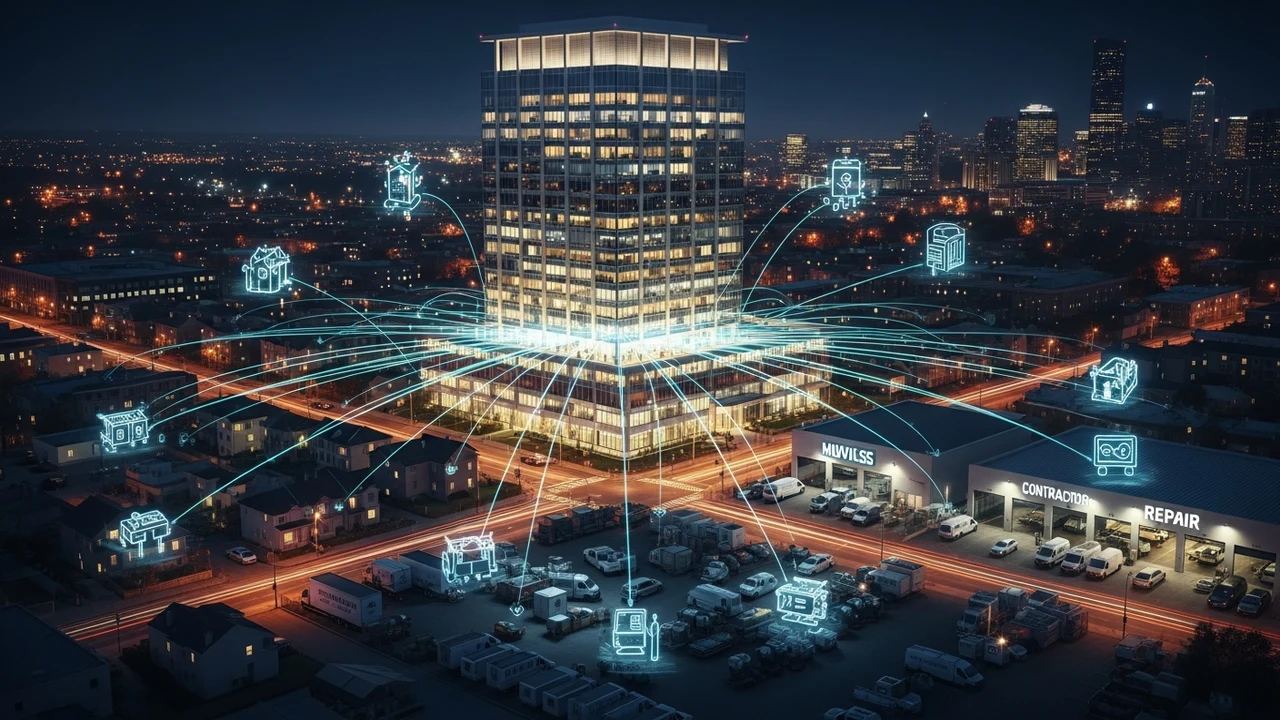
If you want to understand where UCP actually lands in the built environment — property, casualty, services, trades — you have to understand what the insurance carrier does to every transaction it touches. And then you have to imagine what happens when carriers become UCP nodes.
That’s the piece nobody’s writing. So let me write it.
The carrier is already running a commerce network. It just doesn’t look like one.
When a property loss event occurs — water damage, fire, storm — the insurance carrier doesn’t just cut a check. It orchestrates an entire service transaction. It assigns an adjuster. It selects a preferred contractor from its network. It sets scope parameters. It approves or disputes line items. It controls the payment flow. It determines when the job is complete.
That’s not claims processing. That’s commerce orchestration. The carrier is the platform. The contractor is the vendor. The homeowner is the end user who has the least control over the transaction that’s happening inside their own property.
The carrier built this system over decades using phone calls, fax machines, proprietary contractor management software, and preferred vendor agreements. It works — imperfectly, slowly, expensively — because nothing better existed.
UCP is something better.
What a UCP-native carrier looks like.
Imagine the carrier publishes a capability profile as a buyer. Here’s what we need when a loss event occurs: service area, response time commitment, licensing and insurance requirements, scope documentation standards, billing format, communication protocols. All of it structured. All of it queryable by any contractor who wants to be in the network.
The contractor publishes their own profile. Here’s what we do, where we do it, how fast we can respond, what our documentation looks like, what our pricing structure is.
When a loss event occurs, the carrier’s agent queries the contractor network against the loss parameters. Location, loss type, urgency tier, scope complexity. It returns a ranked set of qualified contractors. It initiates the job assignment. It captures the scope at intake. It creates the claim record simultaneously.
No phone calls to find an available contractor at 2am. No manual entry of loss data into a claims system that doesn’t talk to the contractor management system. No week-long delay between loss event and scope documentation because the adjuster’s calendar was full.
The carrier gets faster cycle times, better documentation, lower administrative overhead, and a contractor network that’s continuously evaluated against performance data rather than refreshed every three years when someone remembers to do it.
The contractor gets structured job assignments, clear scope parameters, faster payment because the documentation is clean from intake, and a path into carrier networks that doesn’t require knowing the right regional rep.
The homeowner gets a faster, more transparent process where they can actually see what’s been authorized and why.
The subrogation angle is where it gets really interesting.
Subrogation is the process by which a carrier that paid a claim recovers costs from the party responsible for the loss. The neighbor whose pipe burst and flooded your unit. The contractor whose work failed. The manufacturer whose product malfunctioned.
Right now subrogation is a manual, investigative, often years-long process. The carrier has to establish causation, identify the responsible party, make a demand, negotiate, litigate if necessary. The documentation from the original loss — the scope, the photos, the timeline, the contractor notes — is critical evidence. And it’s often incomplete, inconsistently formatted, and living in three different systems that don’t talk to each other.
A UCP-native loss event generates structured documentation from the moment of intake. The scope is captured in a standard format. The timeline is in the protocol layer. The contractor notes are structured data, not PDFs attached to an email thread.
That documentation package doesn’t just help the homeowner. It feeds directly into subrogation analysis. The carrier’s agent can evaluate subrogation potential at claim close rather than six months later when someone gets around to reviewing the file.
Faster subrogation recovery. Lower loss ratios. Real money.
The preferred network model gets rebuilt from scratch.
Today’s carrier preferred contractor networks are relationship businesses. The regional rep knows the contractors. The contractors know the regional rep. The network gets built through trade show conversations and vendor fairs and whoever had the right contact at the right time.
That’s not a bad system. It produced real relationships and real accountability. But it’s slow to update, geographically constrained, and opaque to the homeowner who has no visibility into why this contractor was selected over that one.
A UCP-native preferred network is performance-based by design. Every job generates structured outcome data. Response time against commitment. Documentation quality. Customer satisfaction. Scope accuracy — did the initial estimate match the final invoice and if not why. Reinspection rate. Supplement rate.
The network updates continuously based on actual performance rather than relationship history. New contractors can get in based on demonstrated capability rather than who they know. Underperforming contractors surface automatically rather than staying in the network because nobody’s reviewed them in two years.
That’s a better network. Better for carriers. Better for homeowners. And actually better for the good contractors who are currently competing on an unlevel playing field against vendors who got in through relationships rather than results.
The carriers that move first on this have a structural advantage.
Cycle time is the metric that matters most in property casualty. Faster claim resolution means lower administrative cost, lower litigation exposure, higher customer satisfaction, and better retention. Every day shaved off average claim cycle is real money at scale.
A carrier that builds UCP-native claims infrastructure shaves days off cycle time across every property loss event they handle. That compounds across millions of claims annually into an expense ratio advantage that competitors can’t easily replicate because it’s embedded in their operational infrastructure, not a product feature.
This isn’t a technology investment. It’s a structural moat.
The carriers that see it that way will move. The ones that see it as an IT project will move slowly. The difference in outcomes between those two groups, five years from now, will be significant.
I’ve sat in enough rooms with carriers and contractors to know the relationship is complicated.
Contractors think carriers underpay and over-control. Carriers think contractors over-scope and under-document. Both are sometimes right. The friction is real and it’s been calcifying for decades.
A shared protocol layer doesn’t fix the relationship. But it does change the terrain. When both sides are working from the same structured data, the arguments shift from “that’s not what was agreed” to “here’s what the data shows.” That’s a better argument to have. It’s faster to resolve and less dependent on who has the better memory or the more persuasive adjuster.
The protocol doesn’t make everyone friends. It makes the transactions cleaner. And cleaner transactions are where trust gets built, slowly, over time, in the way that actually sticks.
The carrier is the most important UCP node in the built environment. Not Google. Not Shopify. Not the retailer with the best checkout flow.
The entity that sits at the center of every property loss transaction, controls the contractor network, sets the documentation standard, and determines when the job is done.
That entity becoming a UCP node changes everything downstream.
And almost nobody is talking about it.
Frequently Asked Questions
What is the Universal Commerce Protocol (UCP)?
The Universal Commerce Protocol (UCP) is an open standard developed to enable AI agents to autonomously conduct commerce transactions across any platform.
How does UCP enable agentic commerce?
UCP provides standardized APIs and protocols so AI agents can discover products, negotiate terms, and complete purchases without human intervention, working across any compatible commerce platform.
Why should businesses implement UCP?
UCP adoption reduces integration costs, opens revenue channels to AI-driven buyers, and future-proofs commerce infrastructure as agentic purchasing becomes mainstream.
Leave a Reply