Q4 2026 holiday commerce proved /.well-known/ucp (RFC 8615), Model Context Protocol (MCP) tools, and Google Merchant supplemental feeds can clear deterministic retail SKU carts at scale. Once seasonal returns settle, Q1 2027 shifts agent-to-agent (A2A) commerce into fragmented services—requiring proactive context telemetry and accountable human specialists.
By Will Tygart · UCP Intelligence Desk · November 26, 2026
Why Holiday Shopping Carts Were Only the Warm-Up
Every retail standard announced in 2026 converged around the same holiday bottleneck: getting an autonomous shopping assistant from a natural-language gift prompt to a verified merchant checkout without breaking tax, shipping, or payment attribution. According to Google’s Universal Commerce Protocol documentation and the Google Developers engineering walkthrough, structured merchant catalogs solve that problem cleanly when a product has a canonical SKU, deterministic warehouse inventory, and a reversible return policy.
Once holiday returns clear in January, however, the protocol conversation hits a far harder frontier: services. As I argued earlier in Services Aren’t Products. Stop Pretending Agentic Commerce Works the Same, high-value service workflows break every comfortable assumption behind e-commerce feeds. You cannot put a fourteen-touch property claim, a multi-leg private flight during storm diversions, or a last-minute chef table in Tribeca into a flat GTIN row and hit add-to-cart.
In physical products, latency and inventory uncertainty are bounded by a warehouse database. In services, capacity is relational, dynamic, and often invisible to public search indices until a trusted counterparty picks up the phone or verifies identity credentials. That structural divide explains why the next serious wave of agent-to-agent commerce after the holidays is not another retail coupon bot—it is hybrid service orchestration.
| Dimension | Q4 2026 Retail SKU Carts | 2027 Service Orchestration | Failure Mode if Unadapted | Production Requirement |
|---|---|---|---|---|
| Discovery Surface | Merchant Center feeds + static /.well-known/ucp manifests | Dynamic capability cards + A2A task endpoints + specialist routing | Agent hallucinates availability or quotes stale rates | Capability schema plus live slot validation |
| Trigger Model | Reactive prompt: user asks to buy a named SKU | Proactive trigger from calendar gaps, flights, or wearables | User falls back to manual search or human assistant | Permissioned event stream with opt-in guardrails |
| Inventory State | Deterministic warehouse count and GTIN price | Non-fungible tables, charters, or off-ledger allocations | Double-booked slots or unfulfilled promise penalties | Hold-and-confirm escrow with human fallback |
| Exception Handling | Standardized shipping carrier and automated return label | Multi-party changes across weather, dietary, or timing shifts | Silent failure mid-itinerary destroys account trust | 24/7 specialist handoff inside shared thread |
| Distribution Economics | Low-margin retail affiliate or native cart checkout fee | High-ticket membership ($5,000 initiation + $10,000/yr) or B2B embed | Negative unit economics from compute and support load | Enterprise partner embed plus high-LTV retention |
What Headless Service Agents Look Like in Production: The Aurora Pattern
One of the clearest live commercial blueprints for this shift is Aurora (Aurora Future Technologies, Inc.), founded in 2024 by Jonah Lowenstein, Aurelius Zwick, and Dmitry Ogurtsov and chaired by Velocity Black founder Alex Macdonald. Backed by $14M from institutional funds and operators (PR Newswire; Fortune), Aurora charges individuals a reported $5,000 initiation fee plus $10,000 annually to manage dining, travel, luxury sourcing, experiences, and longevity.
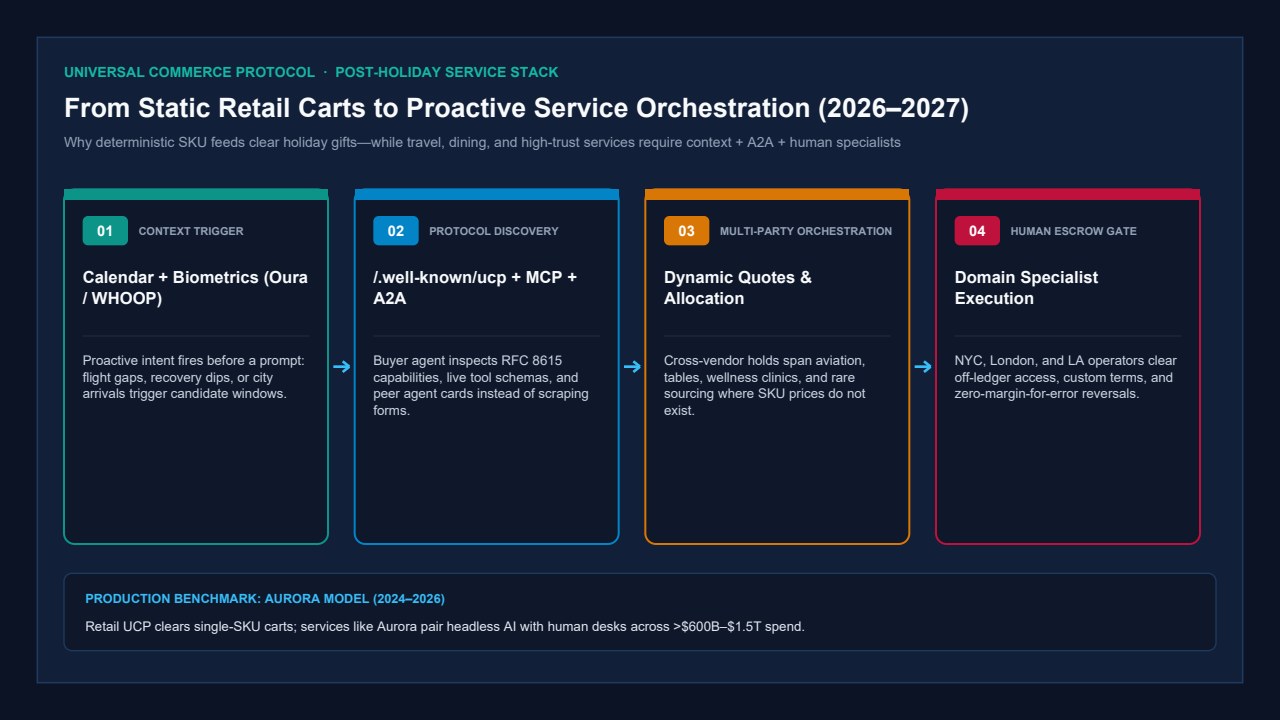
What makes Aurora worth studying from a protocol standpoint is not the luxury branding—it is the exact engineering language published on joinaurora.co/careers. Aurora describes its architecture as “headless, intelligent agents that operate on your behalf” across more than $600 billion to $1.5 trillion of fragmented premium lifestyle spend, built on four distinct execution primitives:
- Proactive Curation Without Prompting: Instead of waiting passively inside a chat prompt, the platform connects to member calendars and wearable telemetry (Oura Ring and WHOOP) to detect travel windows, recovery dips, and social gaps before initiating recommendations.
- Global Multi-Party Orchestration: A single itinerary spans flights, ground transfers, dining holds, and private event access across unconnected vendors—precisely the multi-agent coordination problem that Google’s Agent2Agent (A2A) framework targets.
- Structured Tool Boundaries: Reading personal health signals, executing payment holds, and confirming reservations mirror the scoped tool-invocation discipline documented in the Model Context Protocol (MCP) specification and Anthropic’s tool-use architecture.
- Human Domain Escrow at the Edge: Behind the autonomous software layer sit senior travel and lifestyle specialists in New York, London, and Los Angeles who clear non-API bottlenecks when no automated merchant endpoint exists.
Why Enterprise B2B Distribution Is the Real Tell
If Aurora were purely a $10,000-a-year consumer concierge, protocol architects could dismiss it as a niche luxury wrapper. Yet Aurora’s live Workable Enterprise Lead specification reveals a second, far larger engine: embedding Aurora’s agentic lifestyle layer inside major enterprises across private aviation, hospitality, real estate, and wealth management, where partner end-clients bring hundreds of millions in spend through the system.
Think about what happens once enterprises begin licensing headless service agents rather than building bespoke concierge desks in-house. A wealth-management client’s personal assistant or AI agent does not want to navigate twelve disparate travel portals and restaurant waitlists; it wants one trusted counterparty reachable over structured protocols. That is the exact bridge between closed high-touch concierge networks today and open RFC 8615 capability discovery plus A2A task negotiation tomorrow.
In practice, the companies winning post-holiday service commerce are not waiting for every restaurant host stand or private clinic to deploy a public API. They combine proactive context ingestion on the demand side, deterministic protocol boundaries in the middle, and accountable human operators on the fulfillment edge. Any builder designing UCP endpoints for services in 2027 needs that same three-layer humility: automate context and routing aggressively, enforce explicit permission gates around money and identity, and design clean human escalation paths before a failed booking costs you the customer.
| Protocol / Layer | Canonical Role in Services | Primary Spec Anchor | Operational Boundary |
|---|---|---|---|
| UCP (/.well-known/ucp) | Publishes verifiable business endpoints, payment methods, and identity linking | Google UCP / IETF RFC 8615 | Discovery and settlement frame only; does not resolve taste or bespoke terms |
| Model Context Protocol (MCP) | Connects LLMs cleanly to calendar, CRM, wearable, and vendor lookup tools | modelcontextprotocol.io (2026-07-28) | Enforces scoped tool permissions before mutating external state |
| Agent2Agent (A2A) | Coordinates long-running, stateful negotiation between personal and provider agents | github.com/a2aproject/A2A | Supports asynchronous task updates rather than single HTTP cart calls |
| Human Specialist Escrow | Clears off-ledger reservations, private venues, and complex dispute recovery | Domain Operations Desk (NYC / LDN / LA) | Mandatory fallback whenever trust risk exceeds automated API certainty |
Frequently Asked Questions
Why do agentic commerce protocols hit a wall moving from holiday retail SKUs to services?
Retail products share GTIN barcodes, fixed return windows, and real-time warehouse stock counts that map cleanly to Universal Commerce Protocol cart endpoints. High-trust services such as private travel, luxury dining, longevity clinics, and emergency dispatch depend on off-ledger inventory, multi-party scheduling, and custom pricing that static SKU catalogs cannot encode.
How does Aurora demonstrate the headless agent pattern for luxury services?
Aurora (joinaurora.co) pairs proactive AI orchestration with 24/7 human lifestyle specialists across New York, London, and Los Angeles. Rather than waiting inside a chat box, its platform reads calendar windows and wearable recovery signals like Oura or WHOOP to propose and execute multi-leg dining, travel, wellness, and rare-goods workflows.
How do UCP, MCP, and Agent2Agent (A2A) fit together for service bookings?
Each protocol solves a distinct boundary: UCP exposes machine-readable merchant discovery and payment terms at /.well-known/ucp (RFC 8615), MCP standardizes structured tool invocations and context retrieval for models, and Google's A2A protocol lets a buyer's personal agent negotiate stateful tasks directly with an enterprise provider's fulfillment agent.
Why does enterprise B2B distribution matter more than standalone consumer apps for service agents?
Standalone concierge memberships carry heavy customer-acquisition costs and strict capacity limits, whereas embedding an agentic service desk inside banks, private aviation operators, or wealth platforms brings captive high-spend clients immediately. Aurora's enterprise pipeline shows how one service orchestration layer can monetize hundreds of millions in partner-side spend.
Primary Verification Sources
- Google Merchant UCP Documentation (https://developers.google.com/merchant/ucp)
- Google Developers Blog: Under the Hood of Universal Commerce Protocol (https://developers.googleblog.com/under-the-hood-universal-commerce-protocol-ucp/)
- Google Developers Blog: A2A — A New Era of Agent Interoperability (https://developers.googleblog.com/en/a2a-a-new-era-of-agent-interoperability/)
- Agent2Agent (A2A) Open Protocol Repository (https://github.com/a2aproject/A2A)
- IETF RFC 8615: Well-Known Uniform Resource Identifiers (https://datatracker.ietf.org/doc/html/rfc8615)
- Model Context Protocol Specification (2026-07-28) (https://modelcontextprotocol.io/docs/2026-07-28/getting-started/intro)
- Anthropic Tool Use Overview for Agentic Workflows (https://platform.claude.com/docs/en/agents-and-tools/tool-use/overview)
- Aurora Official Platform & Careers Architecture (https://joinaurora.co/careers)
- PR Newswire: Aurora $14M AI Lifestyle Operating System Launch (https://www.prnewswire.com/news-releases/founders-who-have-created–backed-companies-worth-over-100b-invest-in-new-ai-premium-lifestyle-operating-system-302589252.html)
- Fortune: Inside Aurora's $10,000-a-Year Proactive AI Concierge (https://fortune.com/2026/10/11/meet-aurora-invite-only-ai-concierge-ultrawealthy-pay-10000-a-year-to-anticipate-their-every-need/)
Leave a Reply