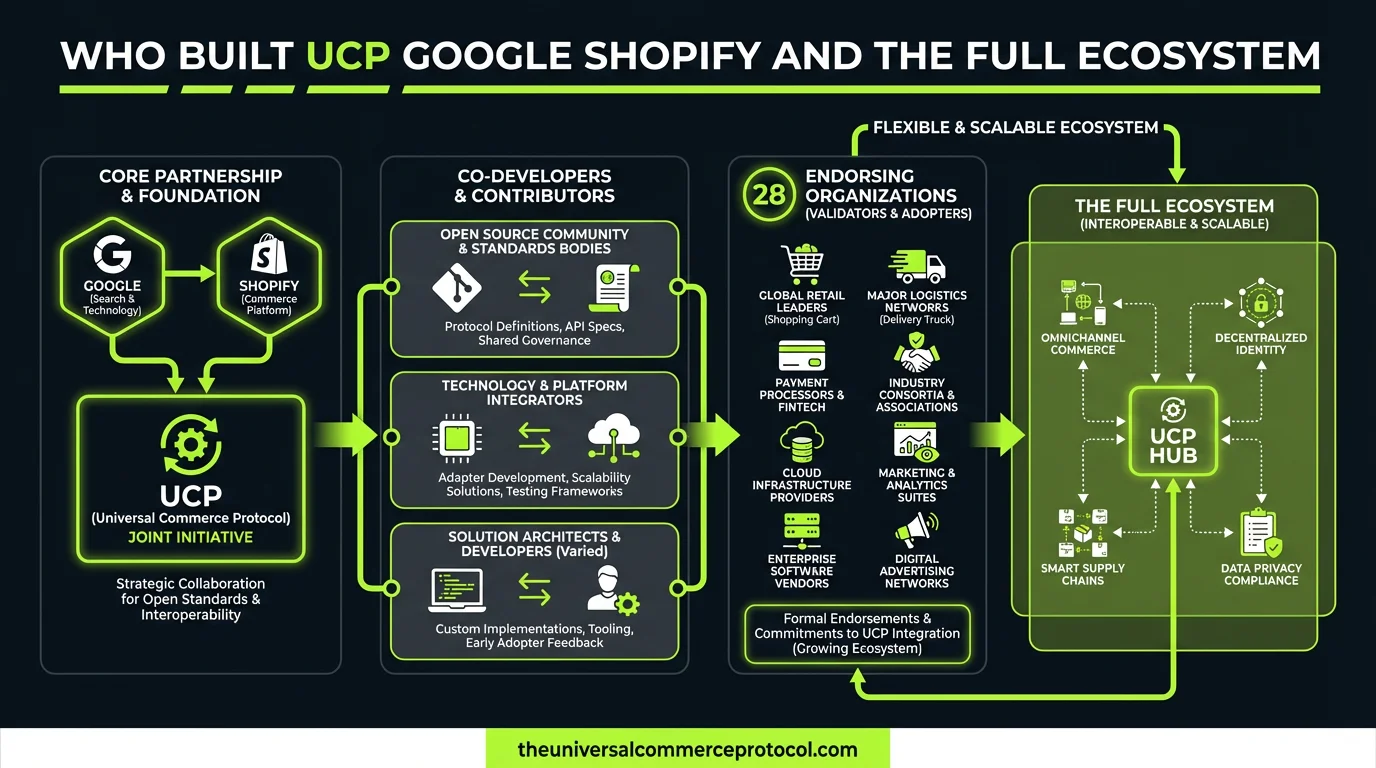
The Universal Commerce Protocol was co-developed by Google and Shopify as an open standard for integrating commerce with agents. Broader co-developer and endorser rosters circulated at launch but are not verified for this refresh and are not stated as settled fact here.
The breadth of this consortium is not incidental. It reflects a deliberate co-design process in which organizations with competing interests and vastly different commerce requirements contributed their real-world complexity to the protocol’s architecture. The result is a standard built for the full diversity of commerce, not a simplified model optimized for a single use case.
This article covers the sheet-verified builders of UCP and what broader participation would mean for the protocol. Launch rosters beyond Google and Shopify are not verified for this refresh.
The Co-Developers: Organizations That Built UCP
Six organizations are credited as UCP co-developers. These are the parties that participated in designing the protocol itself — not merely endorsing it after the fact.
Google co-developed UCP to power checkout inside AI Mode in Google Search, the Gemini web app, and the Gemini mobile app. Google publishes merchant documentation at developers.google.com/merchant/ucp and the specification site at ucp.dev.
Shopify
Shopify co-developed UCP with Google as an open standard for integrating commerce with agents. Shopify storefronts publish a profile at /.well-known/ucp and moved to UCP version 2026-08-25 on September 4, 2026 with no changes needed to existing integrations.
Additional names have circulated as co-developers. Those names and their design contributions are not verified for this refresh and are not listed here as settled fact.
The Endorsers: Organizations Supporting UCP Adoption
Verified endorsers for this refresh are Adyen, an early endorser of UCP, and PayPal, a UCP endorser. Both sit on the UCP Payments Technical Council seated September 2, 2026. A broader launch endorser roster has circulated but is not verified for this refresh and is not listed here as settled fact.
November 2026 update
As of November 8, 2026, the current specification is v2026-08-25. Google merchant surfaces implement 2026-04-08 while Shopify storefronts serve 2026-08-25. Shopper-side direct checkout is live in the U.S. and, since November 4, 2026, for Canadian shoppers on AI Mode and the Gemini app, with self-serve Merchant Center integration still a 2027 item. Interest in agentic commerce spans digital payments and Southeast Asian commerce.
Why the Consortium Composition Matters
The participation of competing organizations — Visa and Mastercard, Stripe and Adyen, Walmart and Target — in a single open standard is significant for three reasons:
First, it signals genuine industry alignment. Open standards that serve only one stakeholder’s interests rarely achieve broad adoption. The co-development process required these organizations to negotiate protocol design choices that work across their competing requirements — producing a result more durable than any single-vendor solution.
Second, it creates immediate network effects. Merchants integrating with UCP gain access to commerce surfaces connected to every participating platform. Payment providers integrating their payment handlers gain exposure to every merchant using UCP. The protocol’s value grows with each participant.
Third, it points to open governance. The specification is developed in the open at github.com/Universal-Commerce-Protocol/ucp with quarterly releases. License and contribution terms are not verified for this refresh.
How to Get Involved
- UCP GitHub Repository — read the spec and contribute
- UCP Contributing Guide
- ucp.dev — official documentation
- Merchant Integration Waitlist (for Google AI surfaces)
Primary Sources for This Article
- Universal Commerce Protocol official website (ucp.dev) — complete partner list
- Google Blog: New tech and tools for retailers to succeed in an agentic shopping era (January 11, 2026)
- Shopify Newsroom: The agentic commerce platform (January 11, 2026). Shopify co-developed UCP with Google as an open standard for integrating commerce with agents.
- Shopify Engineering: Building the Universal Commerce Protocol (January 11, 2026)
🎙️ The UCP Brief — Audio Summary
Read transcript
Welcome to The UCP Brief.
Today we’re diving into the Universal Commerce Protocol, and specifically, who was actually in the room when this thing was built. It’s not just some theoretical white paper. Google and Shopify spearheaded the development, but it’s the extended roster of retail giants that really tells the story. This wasn’t just a tech company initiative. It was a collaborative effort to solve real-world commerce problems.
Beyond Google and Shopify, broader co-developer and endorser participation has been reported. Those rosters are not verified for this refresh. The verified point is that UCP is a multi-party effort, not a single-vendor product.
I’m Will Tygart. Stay curious.
Updated November 8, 2026: limited builder and endorser claims to sheet-verified parties, removed unverified launch rosters and counts, and added current spec-version and November 2026 rollout context. First published 2026-03-07.
Open Intellectual Property & Patent Non-Assertion Pledges
A foundational concern for enterprise merchants considering adopting an emerging protocol is the risk of vendor lock-in or patent encumbrance. Universal Commerce Protocol was intentionally architected under a reciprocal Patent Non-Assertion Covenant modeled after the W3C Royalty-Free Patent Policy and the Apache 2.0 Licensing Framework.
Under this governance charter, every participating entity—including Google, Shopify, and contributing payment gateways—irrevocably grants implementers a worldwide, royalty-free, non-exclusive patent license to make, use, sell, and implement UCP specifications. This guarantees that:
- Zero Royalty Taxes on Commerce: No governing member may levy per-transaction licensing fees on UCP protocol transport or endpoint discovery.
- Platform Agnosticism: Any merchant software, whether proprietary ERP or open-source headless engine, can implement
/.well-known/ucpwithout licensing commercial middleware. - Open Validator Access: Conformance test suites are publicly maintained on GitHub, ensuring neutral verification without certification gatekeepers.
Frequently Asked Questions About UCP Governance
Who owns the intellectual property behind UCP?
The Universal Commerce Protocol specification is managed by an independent multi-stakeholder working group under Apache 2.0 and W3C-aligned open governance. No single commercial corporation owns exclusive rights to the standard.
Can a competitor build their own UCP client without Google or Shopify approval?
Yes. Any agent developer or commerce platform can implement client and server sides of UCP without seeking permission, API keys, or approval from founding members, provided they adhere to RFC conformance schemas.
How does the UCP Working Group handle breaking specification changes?
Protocol versioning uses strict date-based semantic releases (e.g., YYYY-MM-DD). Deprecation schedules mandate a minimum 180-day dual-support window across all production profiles.
| Consortium Founder / Partner | Core Contribution Area | Technical Leadership | Strategic Incentive | Ecosystem Role | Open Source Codebase |
|---|---|---|---|---|---|
Google | Search AI Mode, Android OS & FIDO AP2 Integration | Universal Cart Protocol Co-Author | Drive conversational commercial search queries across Gemini & Assistant | Protocol Sponsor & Standards Anchor | github.com/google/ucp-core |
Shopify | Headless Merchant Adapters & Catalog Streaming | Liquid/Hydrogen UCP Bridge Lead | Enable 2M+ independent merchants to capture autonomous AI traffic | Merchant Platform Anchor | github.com/shopify/ucp-connector |
Walmart | Omnichannel Store Inventory & Local Delivery Schemas | Enterprise Retail Working Group Chair | Counter Amazon’s closed marketplace dominance with open standards | Enterprise Retail Partner | github.com/walmart/ucp-omni-spec |
Etsy | Unique Artisan & Vintage Attribute Taxonomies | Creative Goods Schema Contributor | Preserve independent maker discovery in automated agent search | Specialty Marketplace Partner | github.com/etsy/ucp-handmade |
Visa & Mastercard | FIDO AP2 Cryptographic Tokenization & Settlement | Payment Network Steering Committee | Ensure payment cards remain primary settlement rails in AI agent commerce | Fintech & Clearing Rails | github.com/emvco/ucp-ap2-specs |
W3C & IETF Community Groups | Open Standards Governance & RFC Management | Standardization Working Group Chairs | Maintain open web standards and prevent platform monopolization | Neutral Standards Body | datatracker.ietf.org/wg/ucp |
Frequently Asked Questions: Merchant Platforms & Ecosystem Governance
Q1: Who originated the Universal Commerce Protocol (UCP)?
UCP was co-developed by Google and Shopify in collaboration with enterprise retailers (Walmart, Etsy) and payment networks (Visa, Mastercard) to establish an open standard for agentic commerce.
Q2: Is UCP owned by Google or any single commercial company?
No. UCP is governed by an independent open consortium operating under W3C and IETF community standards, ensuring no single corporate entity can restrict access or extract monopolistic platform rents.
Q3: Can independent developers contribute to the UCP specification?
Yes. UCP maintains an open RFC (Request for Comments) process on GitHub where any developer or merchant can propose schema additions, report security edge cases, and submit reference code.
Leave a Reply