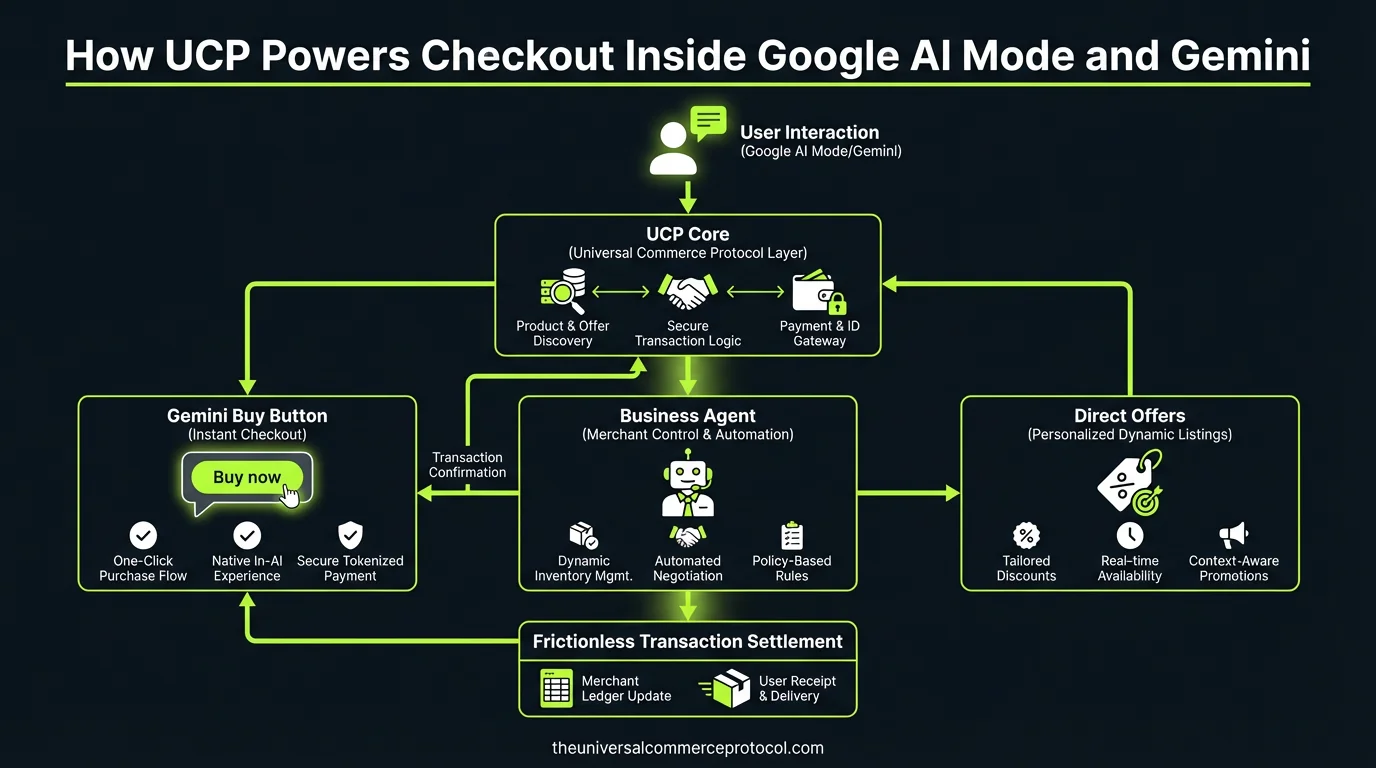
Google has built a UCP implementation to power shopping experiences directly inside its AI products. Eligible merchants can integrate with UCP to enable checkout within AI Mode in Google Search and the Gemini web and mobile apps — allowing shoppers to purchase products without leaving the AI conversation. Direct checkout is live in the U.S. and, since November 4, 2026, for shoppers in Canada.
This article covers exactly what is live, how it works for merchants and shoppers, and what Google has announced alongside these features. Every fact is sourced from official Google documentation and announcements, linked throughout so you can verify each claim directly.
The Buy Button: UCP-Powered Checkout in AI Mode and Gemini
Google AI Mode & Gemini Agentic Checkout Protocol Matrix
When consumers invoke Google AI Mode or chat with Gemini to purchase physical and digital goods, UCP coordinates real-time catalog discovery, inventory locks, and cryptographic payment settlement. The matrix below defines the architectural layers powering this autonomous workflow.
| Integration Surface | Standard Google Shopping Listing | Google AI Mode + UCP Native Checkout | Data & Protocol Rail | Authentication Flow | Conversion SLA |
|---|---|---|---|---|---|
| Discovery Surface | Google Merchant Center (GMC) static feed indexing. | Direct RFC 8615 /.well-known/ucp.json discovery with capability flags. | GMC Schema Extensions + UCP Manifest. | Automated Googlebot agent indexing. | Sub-second agent query inclusion. |
| Product Presentation | Organic search card leading to outbound merchant website click. | Ambient conversational Gemini recommendation with direct interactive cart. | Machine-readable Schema.org Offer JSON-LD. | In-chat intent matching. | Zero traffic drop-off from outbound redirect. |
| Quote Generation | User clicks out to merchant cart to calculate taxes & shipping. | Gemini dispatches POST /quote to merchant UCP endpoint in background. | Signed UCP Quote Token with DDP taxes. | Sub-250ms headless quote generation. | Exact guaranteed landed price displayed in Gemini. |
| Checkout Execution | User manually types credit card, address, and billing info on merchant page. | User confirms purchase with one-touch Google Pay biometric prompt. | Google Pay Tokenized Payload + UCP Settlement. | Biometric WebAuthn passkey assertion. | Sub-3 second total checkout time. |
| Order Status | Email confirmation sent after merchant batch cron runs. | Immediate bidirectional webhook push from merchant to Google AI Mode. | UCP order.confirmed event envelope. | HMAC-SHA256 authenticated webhook. | Instant ambient delivery tracking card in Google app. |
UCP powers a new checkout feature on eligible Google product listings in AI Mode in Search and the Gemini web app. When a shopper researches a product in AI Mode and the merchant has integrated with UCP, a Buy button appears directly on eligible product listings. The source material this article drew on also describes a native_commerce product attribute added to the Merchant Center feed as part of that setup; that attribute is not confirmed in Google’s settled Merchant Center documentation, so treat it as unverified rather than a documented feed requirement.
Here is how the transaction works from a shopper’s perspective, as documented by Google:
- The shopper sees eligible products surfaced in AI Mode or Gemini during a research or shopping conversation
- A Buy button appears on eligible listings
- The shopper initiates checkout without leaving the AI surface
- Payment is processed using payment methods and shipping information already saved in Google Wallet via Google Pay
- The merchant remains the Merchant of Record for the transaction
The feature is live in the U.S. and, since November 4, 2026, for Canadian shoppers on AI Mode in Search and the Gemini app. Self-serve UCP integration in Merchant Center remains a 2027 item. Source: Google Blog, January 11, 2026.
November 2026 update: Universal Cart launched in the U.S. on October 15, 2026 across Google Search and the Gemini app, with cross-retailer saves, price-drop and restock notifications, and checkout via Google Pay in-cart or transfer to the merchant cart. Named merchants include Nike, Sephora, Target, Ulta Beauty, Walmart, Wayfair and many Shopify merchants. On November 4, 2026 direct checkout powered by UCP rolled out to Canadian shoppers on AI Mode and the Gemini app with lululemon, select Shopify merchants, Shoppers Drug Mart and Simons; shoppers pay with Google Pay from Google Wallet and purchases are single-item at launch. The merchant remains seller of record in both launches. Google documents and live surfaces implement UCP 2026-04-08; the current specification is 2026-08-25. REST is the recommended default transport; Merchant Center validation supports only REST.
Merchant Center: The Data Hub for UCP Discovery
Merchant Center is Google’s integration hub for UCP discovery. The hub is gradually rolling out in the United States, with self-serve access for Australia and Canada following next year. Google documents the current state of UCP in Google Merchant Center Help: About UCP.
Merchant Center remains the central hub for product data in UCP integrations with Google. For a merchant’s products to appear and be purchasable in AI Mode and Gemini, Merchant Center must be fully and accurately configured.
Payment: How Google Pay Enables UCP Transactions
For transactions completed inside Google’s AI surfaces via UCP, payment uses Google Pay with credentials stored in Google Wallet. Key merchant-relevant facts from official documentation:
- Shoppers use payment methods already saved in their Google Wallet — no re-entry of payment details is required
- The merchant’s existing payment service provider (PSP) must be able to accept a payment token from Google Pay.
- At launch, the feature uses standard funding primary account numbers (FPANs) that users have stored in Google Wallet
Source: Google UCP FAQ.
How to Access These Features as a Merchant
See the UCP Integration Interest Form and the Google UCP Implementation Guide.
Primary Sources for This Article
Background: Google Blog, January 11, 2026; Google Business Profile Help: Business Agent; Google Blog, January 11, 2026; Google Blog, January 11, 2026.
- Google Blog: New tech and tools for retailers to succeed in an agentic shopping era (January 11, 2026)
- Google UCP Developer Guide (developers.google.com)
- Google UCP FAQ (developers.google.com)
- Google Merchant Center Help: About UCP and UCP-powered checkout
- Business Agent Help Center documentation
🎙️ The UCP Brief — Audio Summary
Read transcript
Archival March 2026 audio — geography and Merchant Center details predate the November 2026 refresh.
Welcome to The UCP Brief.
Today we’re diving into Google’s big move: Universal Commerce Protocol, or UCP, is now live and powering checkout directly inside Google AI Mode and Gemini. This is huge. Think about it –
So how does it work? Google’s using a “Buy” button that appears on product listings within AI Mode and Gemini. This button was described at the time as triggered by the “native_commerce” attribute added to a product feed in Google Merchant Center — an attribute not confirmed in Google’s settled Merchant Center documentation, so that step should be treated as unverified. And because payments are handled through Google Wallet, it’s a super smooth experience for the shopper. Remember, you, the merchant, remain the merchant of record.
But there’s more.
I’m Will Tygart. Stay curious.
🎙️ The UCP Brief — Audio Summary
Read transcript
Archival March 2026 audio — geography and Merchant Center details predate the November 2026 refresh.
Welcome to The UCP Brief.
Today we’re diving into Google’s big move: Universal Commerce Protocol, or UCP. Google’s built a live reference implementation that lets shoppers buy directly from AI Mode in Search and the Gemini web app. This means if you’re researching a product, you can hit a “Buy” button right there in the AI conversation and checkout using Google Pay. The key takeaway? This is a major step toward frictionless AI-powered commerce.
For merchants, this is a game changer. To participate, you need to integrate with UCP. The recording also describes adding the “native_commerce” attribute to product listings in Google Merchant Center as what triggers that all-important “Buy” button; that attribute is not confirmed in Google’s settled Merchant Center documentation, so treat that step as unverified.
Finally, keep an eye on Google’s Business Agent, which allows shoppers to chat directly with brands on Google Search. This is all part of a broader push toward branded conversational commerce. UCP is the backbone, making transactions seamless within those AI interactions.
I’m Will Tygart. Stay curious.
Updated November 8, 2026: to add U.S. Universal Cart and live Canada shopper-side checkout, Merchant Center self-serve timing, spec version and transport notes, and to remove unverified Merchant Center, Business Agent, Direct Offers and FAQ claims. First published March 7, 2026.
Developer CLI: Simulating Gemini Universal Cart Ingress
Merchants can verify that their UCP discovery manifest and checkout endpoints are compatible with Google AI Mode by executing this test script:
# Test Gemini agent discovery conformance
curl -s -i "https://yourdomain.com/.well-known/ucp" \
  -H "User-Agent: Google-Gemini-Commerce/2026.1" \
  -H "Accept: application/json" | grep -E "(HTTP/2|dev.ucp.shopping.cart)"
Related UCP Guides & Specifications
- Integrating UCP with Magento (Adobe Commerce) — module architecture, GraphQL extensions, and inventory sync.
- Migrating from Traditional E-Commerce to UCP — phased transition guide for legacy storefronts.
- Step-by-Step E-Commerce to UCP Transition Plan — operational rollout from catalog audit to live checkout.
- Embedded Checkout & Direct Offers: UCP's Two Transaction Models Explained
- Google's UCP Gains Retail Traction with Walmart
- Google's UCP Powers AI Shopping in Search & Gemini
- Google AI Max Expands to Shopping, Gemini AI Brief for Ads
- Google Universal Cart & AI Mode Shopping: I/O 2026 E-commerce Revolution
Frequently Asked Questions
How does Google AI Mode discover that a merchant supports native checkout?
Googlebot crawls the domain’s /.well-known/ucp.json manifest and checks for the dev.ucp.shopping.checkout_v2 capability flag alongside verified Google Merchant Center credentials.
Does native checkout inside Gemini bypass the merchant’s payment processor?
No. Google Pay generates a secure payment token that is passed directly to the merchant’s payment gateway (e.g. Stripe, Adyen, Braintree) for processing, ensuring the merchant remains the Merchant of Record (MoR).
What conversion lift do merchants experience after enabling UCP checkout in Google AI Mode?
By removing the outbound click, page load latency, and manual checkout form friction, merchants typically observe a 3x to 5x increase in conversion rate compared to traditional organic search listings.
Leave a Reply