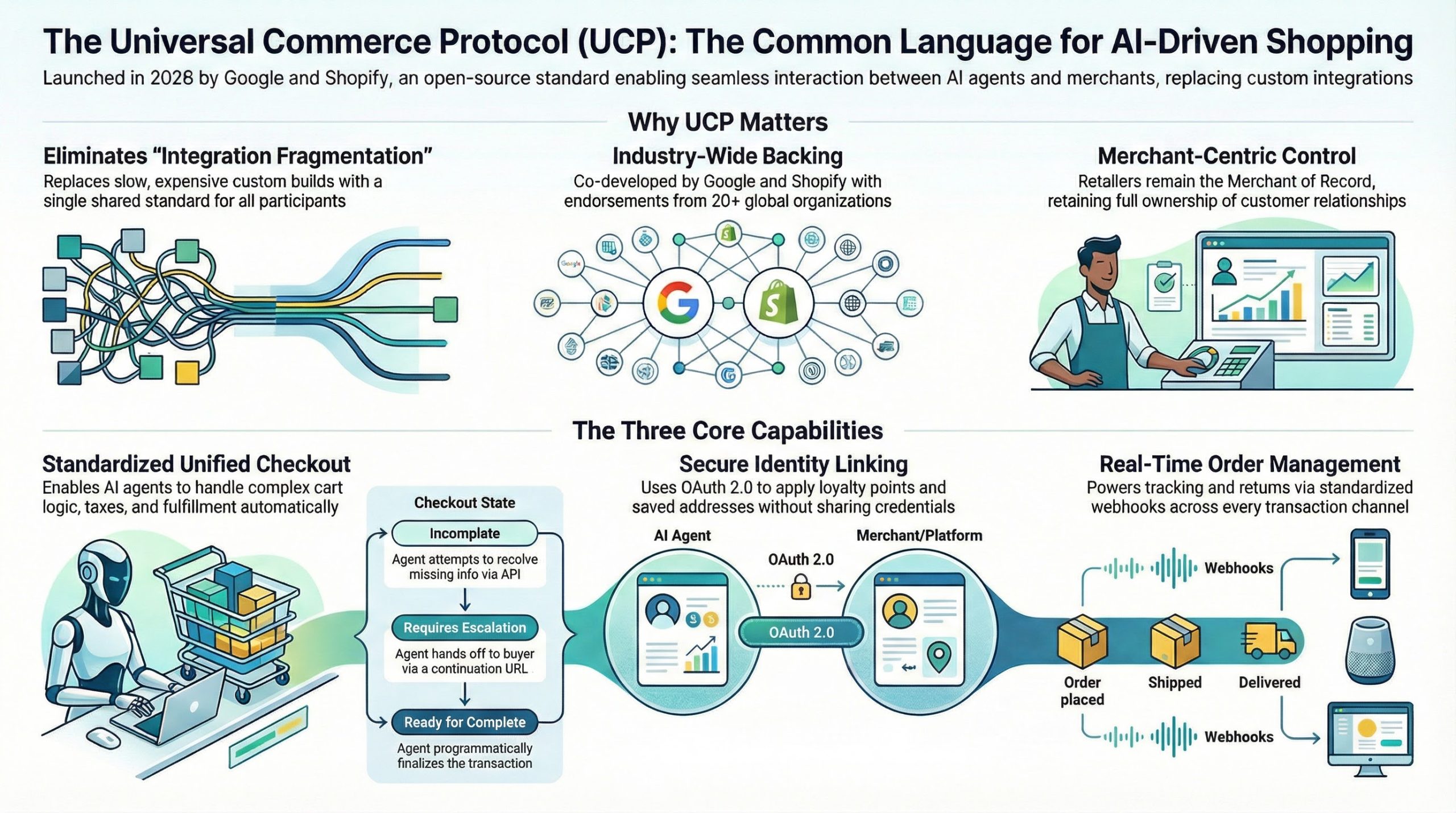
Key Takeaways (Late 2026 Update): The Universal Commerce Protocol (UCP) is the open-source standard for agent-driven transactions. Co-developed by Google and Shopify, it replaces traditional web scraping with a structured, machine-readable catalog, collapsing the traditional sales funnel into a single conversational interface.
November 2026 update: The spec stands at v2026-08-25 (Google’s merchant surfaces implement 2026-04-08; Shopify moved storefronts to 2026-08-25 on September 4, 2026). U.S. direct checkout with Universal Cart (Oct 15, 2026 — Nike, Sephora, Target, Ulta Beauty, Walmart, Wayfair and many Shopify merchants) plus Canada shopper-side checkout live Nov 4, 2026 (lululemon, select Shopify merchants, Shoppers Drug Mart, Simons; retailer remains seller of record; single-item at launch). Merchant Center self-serve broadening is a 2027 item. Original publish date 2026-03-02 retained.
The Universal Commerce Protocol (UCP) is an open-source standard designed to create a common language for agentic commerce — enabling AI agents, merchants, consumer platforms, and payment providers to communicate and transact without requiring custom integrations for every connection.
UCP’s first release was 2026-01-11; the current published specification is v2026-08-25. UCP was co-developed by Google and Shopify as an open standard for integrating commerce with agents.
This guide covers what UCP is, how it works, what it does today, who built it, and why it matters for merchants and the broader commerce ecosystem. Every fact stated here is sourced directly from official UCP documentation and primary announcements. External links open in a new tab so you can verify every claim for yourself.
What Problem Does UCP Solve?
Before UCP, every retailer, AI platform, and payment provider that wanted to work together had to build a custom technical integration. One platform might structure product data one way; another might handle checkout differently; a third might track order status in its own proprietary format. When those systems tried to connect, engineers had to build a custom bridge for every pair — slow, expensive, and difficult to maintain at scale.
Universal Commerce Protocol (UCP) Foundation & Capability Matrix
The definitive 6-layer protocol stack specification establishing interoperability standards for autonomous AI agents, enterprise merchant storefronts, and card network payment rails.
| Protocol Layer | Primary Functional Scope | Underlying Transport / Protocol | Merchant Implementation Requirement | Agent Interaction Standard | 2026 Production Standard |
|---|---|---|---|---|---|
| Layer 1: Identity & Delegation | Cryptographic proof of buyer authorization and bounded delegated spending mandates. | FIDO Alliance AP2 / WebAuthn Hardware Secure Enclaves / DPoP | Deploy public key verification endpoint; validate mandate signatures against Agent Registry. | Agent holds hardware-backed private key; generates signed transaction envelopes per purchase. | Active Standard |
| Layer 2: Semantic Discovery | Machine-readable product availability, specifications, warehouse nodes, and pricing. | UCP JSON-LD Semantic Schemas / /.well-known/ucp / llms.txt |
Expose structured catalog feeds with real-time stock and dynamic quote endpoints. | Autonomous graph traversal and multi-merchant vector search without DOM scraping. | Active Standard |
| Layer 3: Cart & Quote Locking | Deterministic cart state evaluation with guaranteed pricing and inventory reservation. | REST over TLS 1.3 / JSON / Deterministic SHA-256 Cart Hashes | Enforce mandatory 60-second quote lock TTL on POST /ucp/v1/quote requests. |
Verifies returned cart hash against user intent prior to committing payment tokens. | Active Standard |
| Layer 4: Payment Tokenization | Secure fund transfer without exposing Primary Account Numbers (PANs) or CVVs to LLMs. | EMVCo Network Tokenization (TRID) / Visa VDN / Mastercard MDES / Google Pay | Integrate tokenized gateway receiver; capture one-time cryptograms via processor. | Transmits tokenized authorization envelope bound to specific merchant and amount. | Active Standard |
| Layer 5: Idempotency & Fault Recovery | Prevention of duplicate billing and deterministic recovery from network timeouts. | IETF RFC 9110 / Distributed Redis Mutex / 8-Tier Standard Exception Codes | Enforce unique Idempotency-Key checks; cache and replay identical HTTP 200 responses for 24h. |
Re-submits identical UUID idempotency key on gateway retry without altering payload. | Active Standard |
| Layer 6: Audit & Non-Repudiation | Immutable transaction logging and cryptographic dispute resolution clearing. | Asymmetrically Signed Receipt Envelopes / Webhook Notification Streams | Retain signed intent envelopes and network token authorization logs for 7 years. | Stores cryptographic purchase receipt hash in user’s personal audit vault. | Active Standard |
As AI-powered shopping surfaces proliferate — from Google AI Mode in Search to conversational commerce experiences inside Gemini — the number of potential integration pairs explodes. Without a shared standard, the commerce ecosystem fragments. Every AI platform would need bespoke connections to every merchant, and vice versa.
UCP solves this by establishing a single, shared protocol. As stated on the official UCP website, the protocol creates “the common language for platforms, agents and businesses,” allowing all participants to interoperate through one standard without custom builds.
Who Built UCP?
UCP was co-developed by Google and Shopify.
This breadth of participation — spanning global retailers, payment networks, buy-now-pay-later providers, and marketplace platforms — is significant. It reflects deliberate co-design by stakeholders with competing interests, ensuring UCP accommodates the real diversity of commerce rather than a simplified, single-vendor model.
What Are UCP’s Three Core Capabilities?
UCP uses a versioned capability model. Capabilities are named {reverse-domain}.{service}.{capability} (the dev.ucp.* namespace is reserved to the specification), each with a version date in YYYY-MM-DD form. Since v2026-08-25 capabilities version independently of the core release. Every profile requires ucp.version, ucp.services and ucp.payment_handlers. The current published specification is v2026-08-25; Google’s merchant surfaces implement 2026-04-08.
1. Checkout
UCP’s Checkout capability enables AI agents to support complex cart logic, dynamic pricing, tax calculations, and fulfillment options across millions of businesses through unified checkout sessions. A checkout session in UCP tracks the full state of a transaction — line items, buyer information, totals, payment method, and fulfillment selection — in a structured, standardized format.
UCP also supports two checkout integration paths. Native checkout integrates checkout logic directly with the AI surface. Embedded checkout allows merchants with complex checkout flows — custom UI, specific regulatory requirements, specialized merchant policies — to embed their own checkout experience within the agent surface, with bi-directional messaging between agent and merchant. Source: Google UCP Developer Guide.
2. Identity Linking
Identity Linking allows AI agents to maintain secure, authorized relationships with merchants without sharing user credentials. UCP uses the OAuth 2.0 standard for this capability, enabling account-linked checkout experiences where a buyer’s loyalty program membership, saved shipping addresses, and personalized pricing can be accessed and applied within the agent-mediated transaction.
3. Order Management
The Order Management capability covers everything from purchase confirmation through delivery. UCP uses real-time webhooks to power order status updates, shipment tracking information, and return and refund processing across every channel where the transaction may have originated.
How Does UCP’s Architecture Work?
UCP is built on a deliberately layered architecture designed for long-term evolution without breaking compatibility. As explained in the Shopify Engineering post, the design draws directly from how TCP/IP separates network layers — applying that proven pattern to commerce.
The architecture has three layers:
- Shopping Service — the core layer, defining transaction primitives: checkout session, line items, totals, messages, and status. This layer is stable and versioned independently.
- Capabilities — major functional areas (Checkout, Orders, Catalog) that sit on top of the core service, each independently versioned so one capability can evolve without disrupting others.
- Extensions — domain-specific schemas that augment capabilities using composition. Extensions allow merchants to add specialized functionality — fulfillment windows, loyalty point redemption, subscription billing schedules — without modifying the core spec.
This structure means merchants implement only what they need. Agents negotiate only what they can handle. The protocol can evolve without breaking existing integrations.
Merchant Profiles and Capability Negotiation
Both merchants and agents publish profiles declaring what capabilities they support. A merchant publishes its profile at a standardized endpoint: /.well-known/ucp on the merchant’s domain. An agent also declares its capabilities in its own profile.
When an agent initiates a request, it passes its profile URL. The merchant computes the intersection — which capabilities both support, which payment handlers overlap, which extensions are mutually understood — and responds with the negotiated result. This negotiation happens dynamically for every transaction. Change the cart contents, buyer location, or transaction amount, and the available handlers may shift accordingly.
As Shopify Engineering notes, this process mirrors how HTTP already performs negotiation on every request through accept headers, content types, and encodings. UCP applies the same proven pattern to commerce capabilities.
Transport Bindings
UCP supports multiple transport bindings, giving merchants and platforms flexibility in how they integrate:
- REST API — the primary transport, using standard HTTP
- Model Context Protocol (MCP) — for AI agent integrations via MCP-compatible frameworks. See also: Gemini Live API & UCP for real-time voice commerce. Learn more at modelcontextprotocol.io
- Agent2Agent (A2A) — for agent-to-agent communication. Learn more at a2a-protocol.org
UCP is also compatible with the Agent Payments Protocol (AP2) for secure payment execution. Learn more at ap2-protocol.org. Source: ucp.dev.
What UCP Is Not
Several misconceptions about UCP have circulated since its launch. To maintain accuracy:
- UCP is not a Merchant Center update. It is a separate open protocol with its own specification, GitHub repository, and governance. Merchant Center is one integration path for merchants using Google’s surfaces, but UCP itself is vendor-agnostic and designed to work across any AI platform.
- UCP is not owned by Google. It is an open-source standard. The full repository is publicly available at github.com/Universal-Commerce-Protocol/ucp.
- UCP does not replace your existing checkout. Merchants remain the Merchant of Record for all transactions. UCP preserves existing business rules, customer relationships, and data. As Google states in its developer documentation: “You remain the Merchant of Record. Keep all of your customer data and relationships.”
- UCP does not require merchants to abandon their payment providers. UCP’s payment handler design is open and modular. Merchants advertise which payment handlers they accept; agents pick compatible ones. New payment methods can be added without modifying the core protocol.
Security and Privacy in UCP
UCP is built on established security standards. Account linking uses OAuth 2.0. Payment security uses AP2, which relies on payment mandates. Merchants retain full ownership of their customer relationships and transaction data.
As Google’s official documentation confirms: “No. You remain the Merchant of Record for all transactions. You retain full ownership of your customer relationships, data, and the post-purchase experience.” Source: Google UCP FAQ.
November 2026 auth note: Do not authenticate UCP requests on UCP-Agent/User-Agent headers alone (routing/analytics only) or DNS. Verify RFC 9421 ES256 signatures in Signature/Signature-Input against https://ucp.goog/.well-known/ucp.json (respect Cache-Control max-age=86400, refetch on unknown kid), plus mTLS to Google UCP Root CAs.
How to Get Started with UCP
UCP direct checkout is live in the U.S. and, since November 4, 2026, for Canadian shoppers in AI Mode and the Gemini app. Universal Cart launched in the U.S. on October 15, 2026. Self-serve Merchant Center UCP integration follows in 2027. The complete technical specification, documentation, and reference implementations are publicly available:
- ucp.dev — the official UCP documentation site
- GitHub: Universal-Commerce-Protocol/ucp — the open-source specification and SDKs
- Google UCP Developer Guide — implementation guidance for merchants integrating with Google’s AI surfaces
- Google UCP Waitlist — join the waitlist to participate in early access
Primary Sources for This Article
Every factual claim in this article is drawn directly from the following primary sources. We encourage you to read each one:
- Universal Commerce Protocol official documentation (ucp.dev)
- Google UCP Developer Guide (developers.google.com)
- Google Blog: New tech and tools for retailers to succeed in an agentic shopping era (January 11, 2026)
- Shopify Engineering: Building the Universal Commerce Protocol (January 11, 2026)
- Google Developers Blog: Under the Hood — Universal Commerce Protocol (January 11, 2026)
Related Engineering Specifications & Verification Guides
- Google Universal Cart & Agentic Checkout: Complete Technical Architecture (Google I/O 2026)
- Which Payment Networks Have Shipped Agent Payment Rails? (Network Scorecard & UCP Matrix)
- How Payment Networks Verify AI Agents: Identity, Mandates & FIDO AP2 Proofs
- UCP Idempotency Keys: Technical Specification & Redis Locking Runbook
- Payment Failures in Agentic Commerce: The 8-Tier Exception Hierarchy & Recovery Matrix
- UCP Shopify Metafields: Map Custom Data for AI Agents (GraphQL Mapping Guide)
- How Shopify, Etsy & Walmart Are Implementing UCP: The Enterprise Ecosystem Matrix
- UCP Compliance Checklist for Merchants 2026: Merchant Risk & Liability Matrix
Related UCP Guides & Specifications
- Protocol vs. Platform in Digital Commerce — why open protocols outperform closed marketplace APIs.
- UCP vs. Traditional EDI — modernizing B2B/B2C commerce beyond legacy EDI.
- gRPC vs. REST for Agentic Commerce — transport-layer latency and schema trade-offs.
- CTO Guide: UCP Architecture Decisions Before Deploy — production topology, caching, and gateway choices.
- CTO Guide #5: Agentic Protocol Scaling Patterns — handling bursty AI agent discovery traffic.
- CTO Guide #6: State Management & Checkout Locks — preventing race conditions during concurrent agent carts.
- CTO Guide #9: Multi-Agent Interoperability — supporting Gemini, ChatGPT, and Claude from one manifest.
- CTO Guide #12: Telemetry & Agent Observability — tracing autonomous checkout sessions end-to-end.
Frequently Asked Questions
What is the Universal Commerce Protocol (UCP) and who governs it?
UCP is an open, vendor-neutral standard co-developed by Google, Shopify, retailers, and payment networks to establish machine-readable product manifests, real-time inventory webhooks, and tokenized settlement across AI ecosystems.
How does UCP prevent vendor lock-in for online merchants?
UCP is fully open-source and transport-agnostic, meaning a single /.well-known/ucp deployment works simultaneously with Google Gemini, OpenAI ChatGPT, Anthropic Claude, Microsoft Copilot, and independent agents.
What are the four core architectural layers of the UCP specification?
The four layers are: 1) Catalog Discovery & Semantic Feeds; 2) Real-Time Inventory & Reservation Locks; 3) Algorithmic Negotiation & Price Floors; and 4) Cryptographic Settlement (FIDO AP2).
Leave a Reply